Race
Race
Race
9
9
9
min
min
min
Dominic Valerio
Dominic Valerio
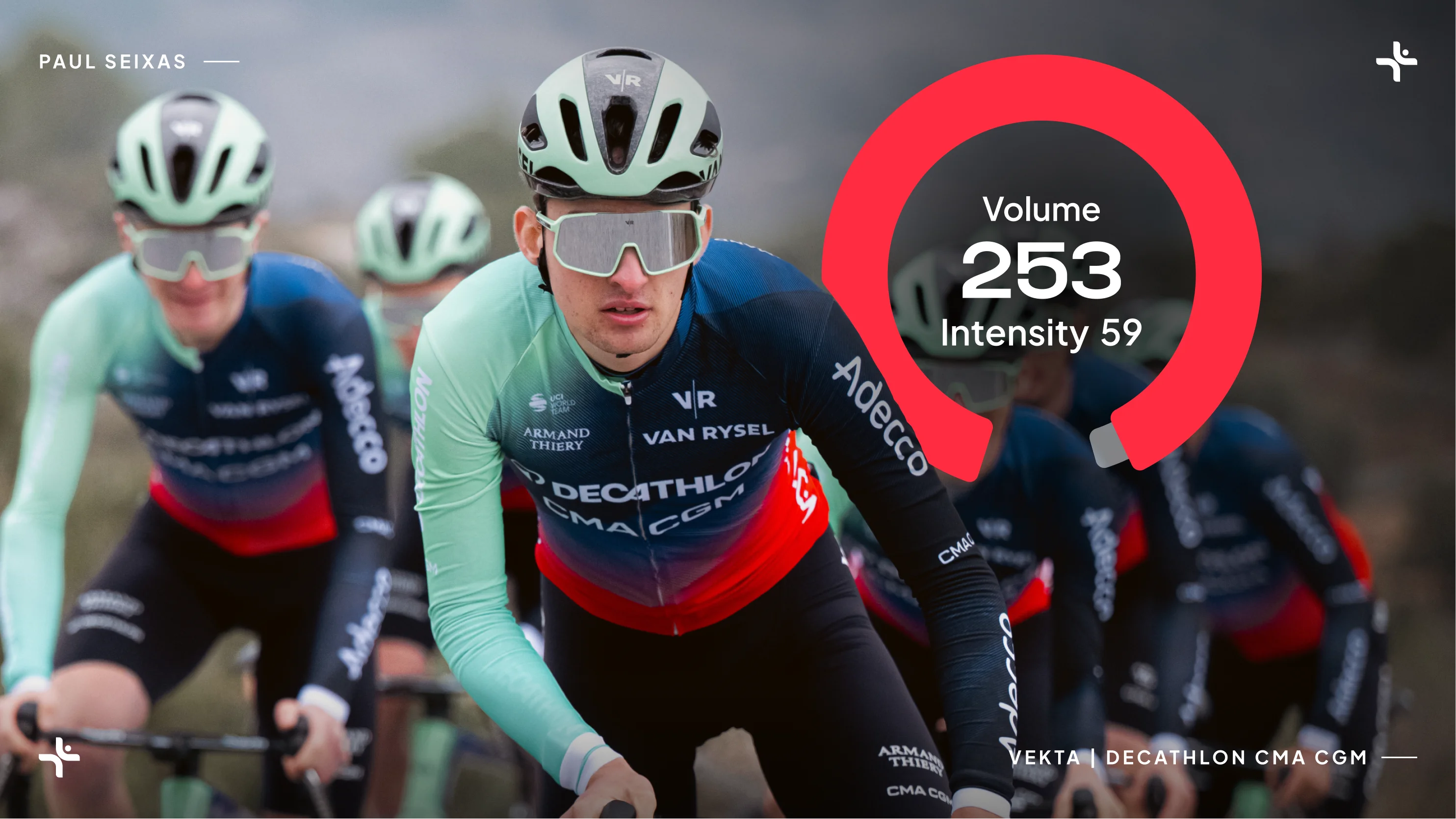
Paul Seixas at Il Lombardia: Volume 253, Intensity 59
Paul Seixas at Il Lombardia: Volume 253, Intensity 59
Key Takeaways
Paul Seixas (Decathlon CMA CGM) won Il Lombardia on 10 October 2026, sixteen days after turning 20. He is the youngest winner in the race's 120 editions, and it is Decathlon CMA CGM's first Monument.
Vekta Volume and Intensity separate how much work a session demanded from how hard that work was for the athlete. Volume is weight-normalised. Intensity is scaled to the athlete's Critical Power (CP), W′ and Pmax, on a range of 0 to 100.
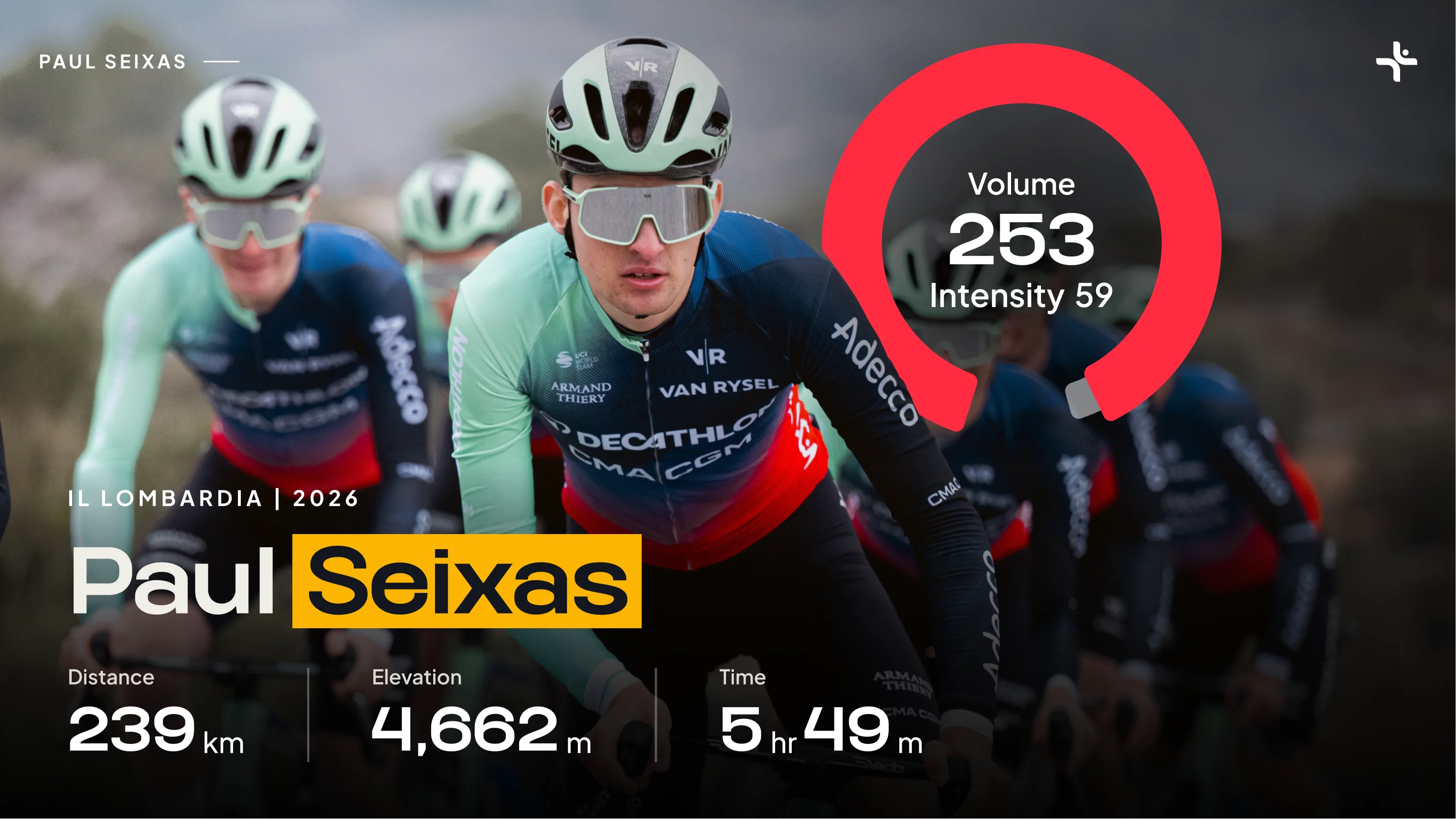
Across 239 km, 4,662 m of climbing and 5h49'28", Seixas recorded a Vekta Volume of 253 and a Vekta Intensity of 59.
Decathlon CMA CGM joined Vekta in 2026, and Seixas trains and races on it. The same two metrics are calculated for every session on the platform, from WorldTour riders to everyday athletes.
In 1905, Giovanni Gerbi won the first Il Lombardia aged 20 years and five months. For the next 119 editions, nobody younger won it. On Saturday, Paul Seixas did.
Sixteen days after his 20th birthday, he rode clear on the Civiglio and arrived alone in Como, 48 seconds ahead of Enric Mas and 1'05" ahead of Giulio Ciccone. It is his first Monument, and the first for Decathlon CMA CGM. Since the finish, much of the analysis has centred on a single climb. That tells you about a few minutes of the race.
Decathlon CMA CGM is a Vekta WorldTour partner, and Seixas trains and races on Vekta. With the team's permission, we can take you inside his data from Saturday: two numbers that describe the race in full, from the start in Bergamo to the line in Como, measured against the athlete who rode it. Together, they answer one question. What does a Monument cost at 20?
The Race Was Decided After 220 Kilometres
After the World Championships in Montréal, Seixas made Lombardia his main target. He did not race again before Bergamo, and by his own account trained hard in between.
239 km from Bergamo to Como. 4,662 m of climbing. 5h49'28" at an average of 41.0 km/h.
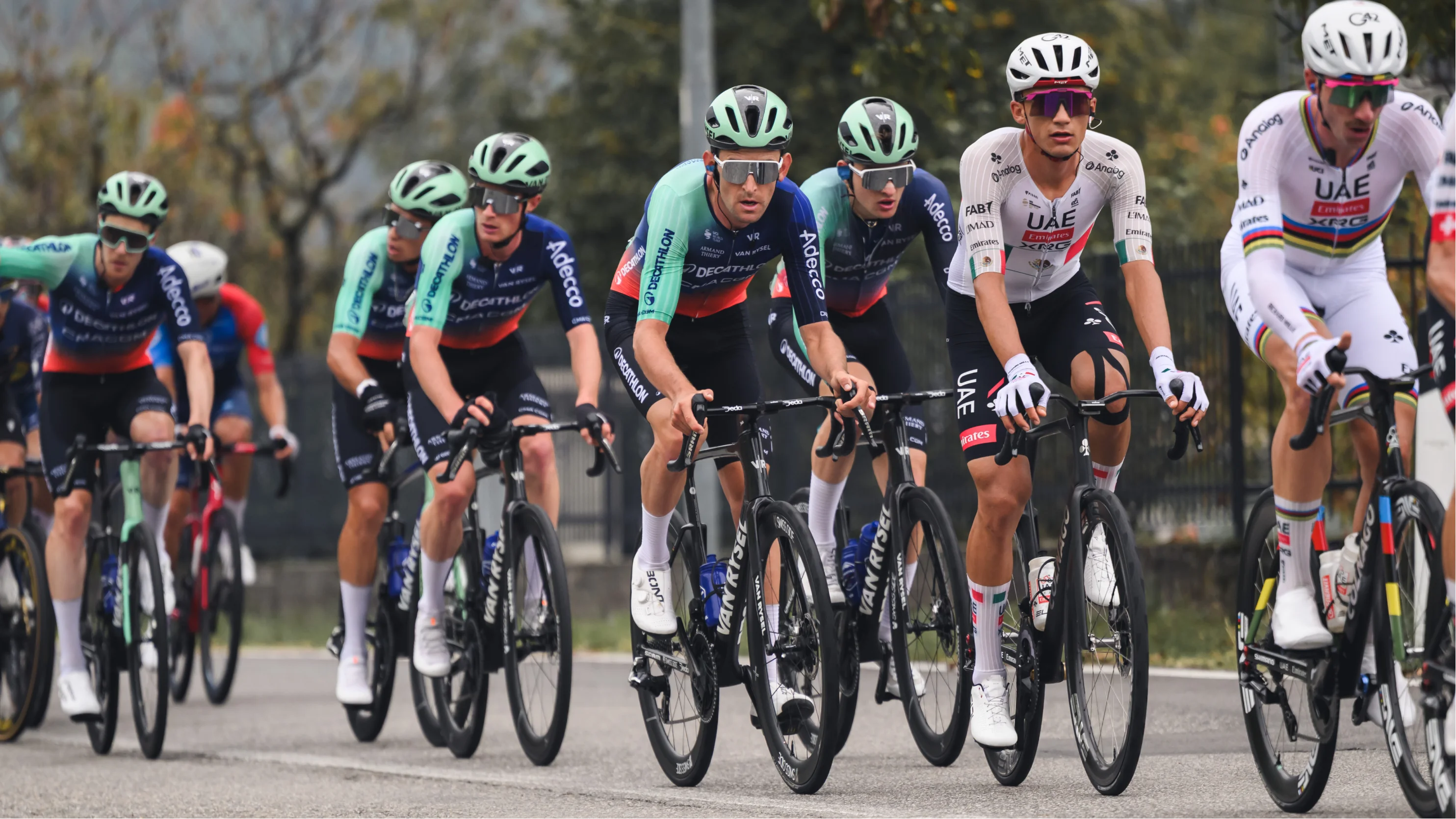
A 14-rider breakaway went clear on the Selvino. Behind it, the race was held together on the climbs around Bergamo and the new ascent to Giovenzana, then stretched thin on the Madonna del Ghisallo. The finale began on San Fermo della Battaglia. The break survived until the Civiglio.
That is where Seixas moved to the front of the favourites and set a pace the others could not hold. Remco Evenepoel went first, then Isaac Del Toro and Brandon McNulty. Tom Pidcock and Ciccone lasted longest. Seixas crested alone, crossed San Fermo a second time with his lead still growing, and rode into Como by himself.
"It was like an individual time trial all the way to the finish."
Paul Seixas, Decathlon CMA CGM
The decisive move came after more than 220 km of racing. Everything that happened before it shaped what it cost.
Power Shows the Output, Not the Cost
Race analysis usually starts and ends with power: average power across the day, or power on the decisive climb. Average power flattens a race, collapsing the fight for the break, the long control on the climbs, the descents and the final solo into one figure. Power on a key climb is sharper, but it captures minutes and strips away everything that came before them. Neither explains what the race took out of the rider.
And a wattage on its own carries no physiology. The same output can sit below one rider's Critical Power and well above another's. Below CP, the demand can be met predominantly aerobically. Above it, the rider draws on W′, a finite reserve of work that only refills once power drops back below CP. Every surge spends from it. Repeated efforts without full recovery cost more each time. The same climb ridden after 220 km of racing is not the same effort as on fresh legs, even at identical watts.
Vekta Volume and Intensity are built around the athlete. Volume is weight-normalised to the rider. Intensity is scaled to the rider's CP, W′ and Pmax. It does not measure watts. It measures what those watts demand of that particular rider. Neither is a snapshot of one climb. Both cover the full race.
Together, they show what a race took out of the rider, in terms that belong to that rider. Because both numbers are personal, they hold their meaning across races, across a season and across riders of different sizes and profiles.
For Paul Seixas at Il Lombardia:
Vekta Volume | 253 |
Vekta Intensity | 59 |
Distance | 239 km |
Elevation | 4,662 m |
Time | 5h49'28" |
Volume 253: The Full Weight of a Monument
Vekta Volume estimates the total work demand of a session. It is weight-normalised, because the same output means something different to a 60 kg rider than to an 80 kg rider. And it has no ceiling: the more you do, the higher the score.
Seixas's Volume of 253 is the size of his Lombardia: 239 kilometres and 4,662 metres of climbing, scaled to his body weight.
Volume tells you how big the day was. It does not tell you how hard.
Intensity 59: Lombardia, Measured Against Seixas
Vekta Intensity captures how hard a session was, regardless of how long it lasted. It runs from 0 to 100, and it is calculated continuously through the session as local intensity, then aggregated.
The physiology behind it starts with CP, the boundary between the heavy and severe intensity domains. Below it, effort is sustainable for long periods. Above it, the cost rises steeply and W′ starts to drain. How often a rider crosses that line, how far, for how long and with how little recovery in between is what separates a hard race from a long one.
Intensity models that directly:
Above-CP weighting. Efforts above Seixas's CP count disproportionately, because that is where effort becomes disproportionately costly.
Athlete-specific scaling. The scale is set by his CP, W′ and Pmax, so a climber, a sprinter and a time triallist are each measured on a fair scale. 59 is his number, on his scale.
Cumulative fatigue. Repeated and prolonged efforts amplify local intensity. Lombardia's finale stacks them: the Ghisallo, San Fermo, the Civiglio, San Fermo again, then the run to Como alone.
Because Intensity is independent of duration, Seixas's 59 is not inflated by nearly six hours in the saddle. It is the aggregate of every moment of local intensity across 5h49'28", each one weighted by where it sat against his own physiology.
That is the cost of a Monument at 20.
His Scale Will Move With Him
Seixas is 20. A year ago, he finished seventh at Il Lombardia, 4'16" behind the winner. Twelve months later, he came back and won it.
His CP, W′ and Pmax will keep moving as he develops. Vekta updates them from his completed rides, without the need for formal testing, and his Intensity scale moves with them. As his capacity grows, the same effort will score lower. The next time he lines up in Bergamo, the same roads will be measured against a different athlete.
For every athlete, that is what keeps Intensity honest. As fitness changes, the scale changes with it, so a score always reflects what a session asked of the rider at that point in their development.
One Score Hides What Two Reveal
Most legacy systems give a session one score. Training Stress Score® (TSS®) blends how much you did with how hard you did it. A long, steady ride and a shorter session of repeated hard efforts can return similar scores, despite very different demands and very different recovery needs.
Separate the two and a race becomes readable. Volume shows the total load. Intensity shows how demanding that load was for the athlete. Together, they show whether fatigue came from the total load or from extreme moments of intensity. A Monument holds both.
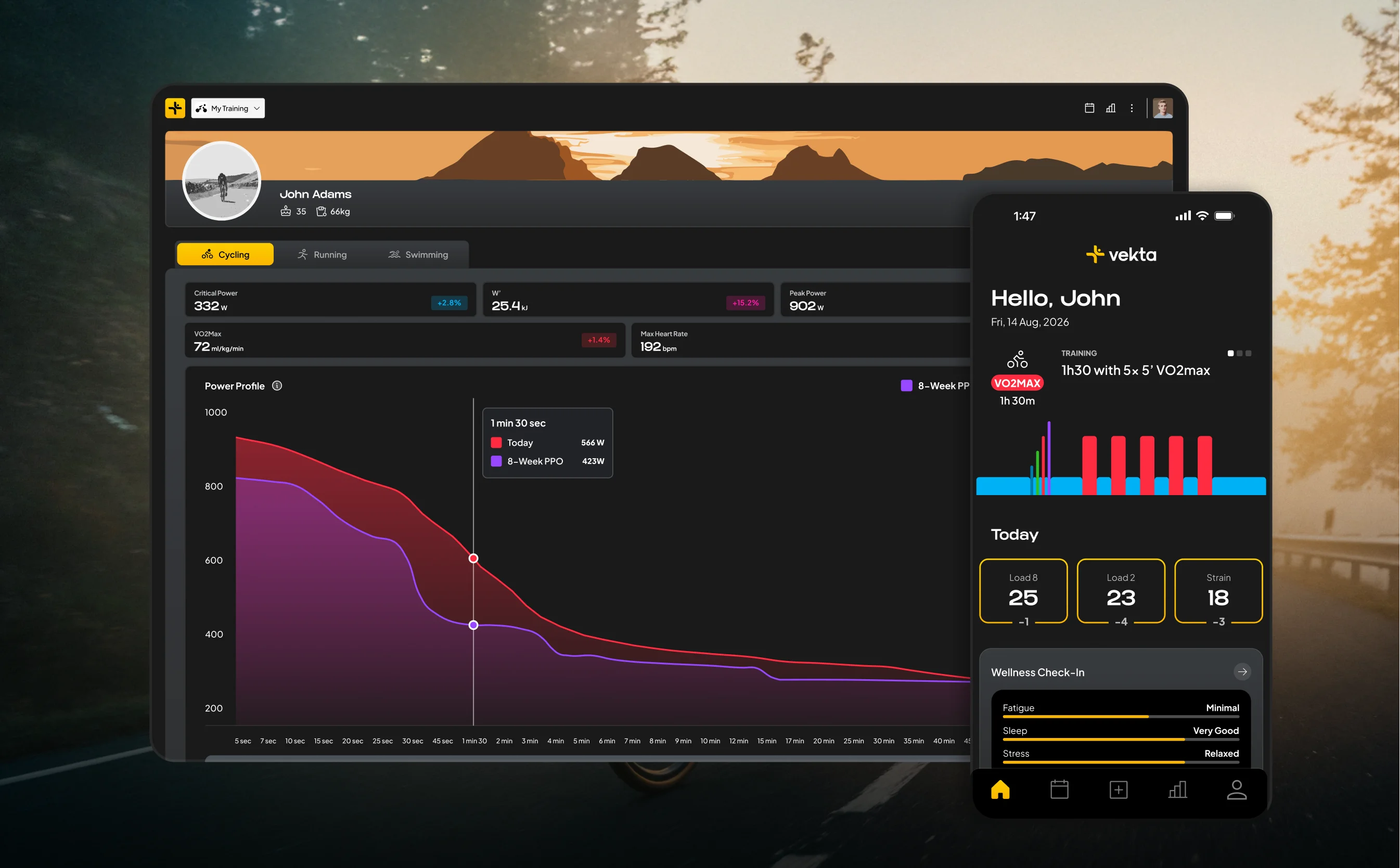
That separation runs through the whole platform. Vekta Load-8 and Load-2 track Volume over eight weeks and two weeks. Vekta Strain tracks Intensity. The long-term picture is built from the same two signals as the single race.
Inside Decathlon CMA CGM's Performance Programme
Decathlon CMA CGM joined Vekta in February 2026, alongside Lidl-Trek and Team TotalEnergies. They joined existing partners Team Jayco AlUla, Liv AlUla Jayco, FDJ United-SUEZ and Team AMANI: seven teams on Vekta in under a year. Decathlon CMA CGM uses the platform across its WorldTour, development and junior programmes. Seixas's 2026 season, the team's first on Vekta, included Itzulia Basque Country, La Flèche Wallonne and fourth overall on his Tour de France debut, before Lombardia.
Alex Welburn of Decathlon CMA CGM, a researcher in Critical Power and W′ Balance, has described exactly the problem that separating Volume and Intensity solves.
"You can have two riders with the same total load, but one is constantly dipping above CP while the other stays just below. On paper, they look identical. In reality, they're adapting in completely different ways."
Alex Welburn, Decathlon CMA CGM
That is the gap a single score leaves open, and the one Volume and Intensity are built to close.
Every Session, Read the Same Way
The same two numbers sit on every session in Vekta, for every athlete, calculated the same way whether the session is a Monument or a Tuesday training ride.
For a coach reading a race, Volume gives the size of the day and Intensity gives how hard it was for the athlete. The Intensity stream then shows where that cost came from, whether in the early fight, the repeated climbs or the decisive move.
For planning, the separation shows what a week actually delivered. High-Volume weeks build the aerobic base, and high-Intensity days sharpen for competition. A day high in both signals the need for extra recovery, and it is visible as soon as the session uploads.
Over a season, Load-8, Load-2 and Strain carry the same separation forward, showing whether the next block should add work or absorb it.
The Same Platform, Available to You
Seixas trains and races on Vekta. So do the riders and coaches of seven WorldTour and professional teams, including FDJ United-SUEZ, Lidl-Trek and Team Jayco AlUla. The same platform, and the same Volume and Intensity on every session, is available to every coach and athlete.
Further reading: Leo, P., Spragg, J. and Wakefield, J. (2022). The Compound Score in elite road cycling.
Training Stress Score® (TSS®) is a registered trademark owned by TrainingPeaks, LLC.
Photo: ©P.Ballet/A.Broadway
Key Takeaways
Paul Seixas (Decathlon CMA CGM) won Il Lombardia on 10 October 2026, sixteen days after turning 20. He is the youngest winner in the race's 120 editions, and it is Decathlon CMA CGM's first Monument.
Vekta Volume and Intensity separate how much work a session demanded from how hard that work was for the athlete. Volume is weight-normalised. Intensity is scaled to the athlete's Critical Power (CP), W′ and Pmax, on a range of 0 to 100.
Across 239 km, 4,662 m of climbing and 5h49'28", Seixas recorded a Vekta Volume of 253 and a Vekta Intensity of 59.
Decathlon CMA CGM joined Vekta in 2026, and Seixas trains and races on it. The same two metrics are calculated for every session on the platform, from WorldTour riders to everyday athletes.
In 1905, Giovanni Gerbi won the first Il Lombardia aged 20 years and five months. For the next 119 editions, nobody younger won it. On Saturday, Paul Seixas did.
Sixteen days after his 20th birthday, he rode clear on the Civiglio and arrived alone in Como, 48 seconds ahead of Enric Mas and 1'05" ahead of Giulio Ciccone. It is his first Monument, and the first for Decathlon CMA CGM. Since the finish, much of the analysis has centred on a single climb. That tells you about a few minutes of the race.
Decathlon CMA CGM is a Vekta WorldTour partner, and Seixas trains and races on Vekta. With the team's permission, we can take you inside his data from Saturday: two numbers that describe the race in full, from the start in Bergamo to the line in Como, measured against the athlete who rode it. Together, they answer one question. What does a Monument cost at 20?
The Race Was Decided After 220 Kilometres
After the World Championships in Montréal, Seixas made Lombardia his main target. He did not race again before Bergamo, and by his own account trained hard in between.
239 km from Bergamo to Como. 4,662 m of climbing. 5h49'28" at an average of 41.0 km/h.
A 14-rider breakaway went clear on the Selvino. Behind it, the race was held together on the climbs around Bergamo and the new ascent to Giovenzana, then stretched thin on the Madonna del Ghisallo. The finale began on San Fermo della Battaglia. The break survived until the Civiglio.
That is where Seixas moved to the front of the favourites and set a pace the others could not hold. Remco Evenepoel went first, then Isaac Del Toro and Brandon McNulty. Tom Pidcock and Ciccone lasted longest. Seixas crested alone, crossed San Fermo a second time with his lead still growing, and rode into Como by himself.
"It was like an individual time trial all the way to the finish."
Paul Seixas, Decathlon CMA CGM
The decisive move came after more than 220 km of racing. Everything that happened before it shaped what it cost.
Power Shows the Output, Not the Cost
Race analysis usually starts and ends with power: average power across the day, or power on the decisive climb. Average power flattens a race, collapsing the fight for the break, the long control on the climbs, the descents and the final solo into one figure. Power on a key climb is sharper, but it captures minutes and strips away everything that came before them. Neither explains what the race took out of the rider.
And a wattage on its own carries no physiology. The same output can sit below one rider's Critical Power and well above another's. Below CP, the demand can be met predominantly aerobically. Above it, the rider draws on W′, a finite reserve of work that only refills once power drops back below CP. Every surge spends from it. Repeated efforts without full recovery cost more each time. The same climb ridden after 220 km of racing is not the same effort as on fresh legs, even at identical watts.
Vekta Volume and Intensity are built around the athlete. Volume is weight-normalised to the rider. Intensity is scaled to the rider's CP, W′ and Pmax. It does not measure watts. It measures what those watts demand of that particular rider. Neither is a snapshot of one climb. Both cover the full race.
Together, they show what a race took out of the rider, in terms that belong to that rider. Because both numbers are personal, they hold their meaning across races, across a season and across riders of different sizes and profiles.
For Paul Seixas at Il Lombardia:
Vekta Volume | 253 |
Vekta Intensity | 59 |
Distance | 239 km |
Elevation | 4,662 m |
Time | 5h49'28" |
Volume 253: The Full Weight of a Monument
Vekta Volume estimates the total work demand of a session. It is weight-normalised, because the same output means something different to a 60 kg rider than to an 80 kg rider. And it has no ceiling: the more you do, the higher the score.
Seixas's Volume of 253 is the size of his Lombardia: 239 kilometres and 4,662 metres of climbing, scaled to his body weight.
Volume tells you how big the day was. It does not tell you how hard.
Intensity 59: Lombardia, Measured Against Seixas
Vekta Intensity captures how hard a session was, regardless of how long it lasted. It runs from 0 to 100, and it is calculated continuously through the session as local intensity, then aggregated.
The physiology behind it starts with CP, the boundary between the heavy and severe intensity domains. Below it, effort is sustainable for long periods. Above it, the cost rises steeply and W′ starts to drain. How often a rider crosses that line, how far, for how long and with how little recovery in between is what separates a hard race from a long one.
Intensity models that directly:
Above-CP weighting. Efforts above Seixas's CP count disproportionately, because that is where effort becomes disproportionately costly.
Athlete-specific scaling. The scale is set by his CP, W′ and Pmax, so a climber, a sprinter and a time triallist are each measured on a fair scale. 59 is his number, on his scale.
Cumulative fatigue. Repeated and prolonged efforts amplify local intensity. Lombardia's finale stacks them: the Ghisallo, San Fermo, the Civiglio, San Fermo again, then the run to Como alone.
Because Intensity is independent of duration, Seixas's 59 is not inflated by nearly six hours in the saddle. It is the aggregate of every moment of local intensity across 5h49'28", each one weighted by where it sat against his own physiology.
That is the cost of a Monument at 20.
His Scale Will Move With Him
Seixas is 20. A year ago, he finished seventh at Il Lombardia, 4'16" behind the winner. Twelve months later, he came back and won it.
His CP, W′ and Pmax will keep moving as he develops. Vekta updates them from his completed rides, without the need for formal testing, and his Intensity scale moves with them. As his capacity grows, the same effort will score lower. The next time he lines up in Bergamo, the same roads will be measured against a different athlete.
For every athlete, that is what keeps Intensity honest. As fitness changes, the scale changes with it, so a score always reflects what a session asked of the rider at that point in their development.
One Score Hides What Two Reveal
Most legacy systems give a session one score. Training Stress Score® (TSS®) blends how much you did with how hard you did it. A long, steady ride and a shorter session of repeated hard efforts can return similar scores, despite very different demands and very different recovery needs.
Separate the two and a race becomes readable. Volume shows the total load. Intensity shows how demanding that load was for the athlete. Together, they show whether fatigue came from the total load or from extreme moments of intensity. A Monument holds both.
That separation runs through the whole platform. Vekta Load-8 and Load-2 track Volume over eight weeks and two weeks. Vekta Strain tracks Intensity. The long-term picture is built from the same two signals as the single race.
Inside Decathlon CMA CGM's Performance Programme
Decathlon CMA CGM joined Vekta in February 2026, alongside Lidl-Trek and Team TotalEnergies. They joined existing partners Team Jayco AlUla, Liv AlUla Jayco, FDJ United-SUEZ and Team AMANI: seven teams on Vekta in under a year. Decathlon CMA CGM uses the platform across its WorldTour, development and junior programmes. Seixas's 2026 season, the team's first on Vekta, included Itzulia Basque Country, La Flèche Wallonne and fourth overall on his Tour de France debut, before Lombardia.
Alex Welburn of Decathlon CMA CGM, a researcher in Critical Power and W′ Balance, has described exactly the problem that separating Volume and Intensity solves.
"You can have two riders with the same total load, but one is constantly dipping above CP while the other stays just below. On paper, they look identical. In reality, they're adapting in completely different ways."
Alex Welburn, Decathlon CMA CGM
That is the gap a single score leaves open, and the one Volume and Intensity are built to close.
Every Session, Read the Same Way
The same two numbers sit on every session in Vekta, for every athlete, calculated the same way whether the session is a Monument or a Tuesday training ride.
For a coach reading a race, Volume gives the size of the day and Intensity gives how hard it was for the athlete. The Intensity stream then shows where that cost came from, whether in the early fight, the repeated climbs or the decisive move.
For planning, the separation shows what a week actually delivered. High-Volume weeks build the aerobic base, and high-Intensity days sharpen for competition. A day high in both signals the need for extra recovery, and it is visible as soon as the session uploads.
Over a season, Load-8, Load-2 and Strain carry the same separation forward, showing whether the next block should add work or absorb it.
The Same Platform, Available to You
Seixas trains and races on Vekta. So do the riders and coaches of seven WorldTour and professional teams, including FDJ United-SUEZ, Lidl-Trek and Team Jayco AlUla. The same platform, and the same Volume and Intensity on every session, is available to every coach and athlete.
Further reading: Leo, P., Spragg, J. and Wakefield, J. (2022). The Compound Score in elite road cycling.
Training Stress Score® (TSS®) is a registered trademark owned by TrainingPeaks, LLC.
Photo: ©P.Ballet/A.Broadway
Try Vekta free
Put the theory to work
Vekta is where coaches and athletes plan the work, see the numbers, and track what actually changes.
Try Vekta free
Put the theory to work
Vekta is where coaches and athletes plan the work, see the numbers, and track what actually changes.
Frequently asked questions
Frequently asked questions
Brand Director

