Platform Updates
Platform Updates
Platform Updates
10
10
10
min
min
min
Dominic Valerio
Dominic Valerio
Introducing the Vekta API: A Performance Department in a Key
Introducing the Vekta API: A Performance Department in a Key
The whole model, open to any question and anything you want to build
Ask what an athlete can actually hold after 1,200 kilojoules rather than fresh. Run a readiness pass across nine athletes before breakfast and know which two need your attention. Trace which sessions in a six week block moved the needle and which ones cost more than they returned.
None of this is exotic. It is what a WorldTour performance department does on an ordinary Tuesday. What it takes is a building full of people: an analyst who writes code, a sports scientist who knows which question is worth asking, and the budget that carries them. Which is why every coach outside that short list of teams has been running on instinct plus whatever the interface would agree to show them.
The Vekta API is live today, and it is available to any coach or athlete with a Vekta subscription.
Every ride still feeds the model. What changes today is what you can do with it. Ask it anything you have ever wanted to ask about an athlete and get an answer in seconds. Build the system you have always wanted and never had the means to make. Find the things in your own data that nobody has been able to look for yet.
Work that used to take a performance department now takes a question.
What Does the Vekta API Unlock?
This is not a data export. Exports give you rows, and rows are the easy part. What the Vekta API returns is the modelled layer: the same interpreted data the platform itself runs on. Ten endpoints. Nine of them read, and the one that writes sends an athlete an invitation.
Sessions
More than forty summary fields per activity, covering power, normalised power, heart rate, cadence, temperature, elevation, work in kilojoules, calories, RPE and how the athlete said they felt. Alongside them sit Vekta Volume and Intensity, the dominant training stimulus Vekta classified for that session, and an AI-generated summary of what happened.
Efforts, already read
Laps come back Vekta-classified, each stamped with an intensity label and, where Vekta detected one, a secondary characteristic: maximum, torque, cadence, progressive, intra-recovery, dynamic. Climbs are detected automatically with average and maximum gradient, power per kilo and elevation. Laps and climbs are returned for cycling; pool swims come back as lengths, with stroke type and stroke count. This is the automatic interval detection engine, exposed.
And the raw provider laps arrive alongside the classified ones, unmodelled. You can see the original recording and Vekta's reading of it side by side, which is a level of transparency worth having in a dataset you intend to build on.
Telemetry
Per second streams for any session. Power, heart rate, cadence, speed, altitude, grade, position, temperature, left and right balance, torque, W′ balance and intensity, with core temperature, skin temperature, heat strain, breathing rate, tidal volume, minute ventilation, fluid and sodium loss, and running dynamics for athletes carrying the hardware. A channel is only absent when no sensor recorded it on that ride.
Prescriptions
Fully machine readable, with nested steps and repetition blocks. Targets come back in absolute terms and as a percentage of the athlete's own model, whether the session is prescribed from power, heart rate or pace, along with carbohydrate intake. Once a planned session is paired with what was actually ridden, the prescription carries the activity id. Both halves of coaching, what was asked for and what was done, come from the same place.
Daily physiology
The full history of critical power, W′, D′, VO₂max, max power, critical speed, max and resting heart rate, weight, SpO₂ and body fat. Every value flagged as measured by the athlete or estimated by Vekta, so you always know what is a reading and what is a model.
Sleep
Stages, HRV, resting heart rate and skin temperature measured against the athlete's own baseline, from a connected device.
Notes and events
The calendar context that explains the numbers. Notes carry their type, so a rest day, an illness, a nutrition change or an availability problem arrives labelled rather than buried in free text. Events carry the planned race, its date, distance, elevation and target, and pair to the activity once it has been ridden.
Durability
Every lap and every climb carries workBefore: the kilojoules already completed at the moment that effort began. It changes the nature of what can be asked, because it means every effort in an athlete's history knows how much work preceded it. You stop looking at what an athlete can do and start looking at what an athlete can do under fatigue. Durability stops being a concept you discuss and becomes something you query.
The API is included with every Vekta subscription. There is no separate charge and no plan tier.
Want access to the Vekta API? Request your key or start your 14-day free trial
Most Training APIs Are Not For You
Every training platform asks the same thing of its users. Here is your data. Here is our interpretation of it. Here is the view we think you need. It holds up right until a coach wants something specific, and they always want something specific, because no two coaches are the same and no two athletes are the same.
Training APIs are not new either. The question was always who was allowed through. TrainingPeaks runs a partner API for approved commercial developers and states plainly that it is not available for personal use. Xert and WKO5 have no public API. Intervals.icu does issue keys to individuals, and a large community has been built on it.
Vekta's answer is that the person who should be able to reach an athlete's data is the person who knows the athlete. No company to register. No commercial application to describe. No approval queue.
Start by Asking
Connected to an assistant, the API answers what you would otherwise ask a very patient analyst. Here is what comes back.

For the coach.
Which athlete needs my attention today?
Sleep, HRV, resting heart rate and skin temperature read against each athlete's own baseline rather than a population average, with their notes alongside. You decide what counts as attention and what gets ignored. Including the athletes who need nothing from you at all, which is where the time is actually saved.
Who has completed their sessions this week?
Every prescription carries the activity id it was paired with, so the compliance check that normally means opening every calendar in turn becomes one answer.
Write me her race week report.
Everything the week has actually contained, her current numbers, and how both compare to the last time she went into a race in the shape you wanted. Sessions, prescriptions, notes and physiology pulled in one pass, in whatever form is actually useful to you. A report most coaches have never had the hours to produce.
Did that block work?
Every session in it, with the stimulus, volume and intensity it carried, read against how her physiology moved underneath. Critical power, W′, recovery markers, sleep, and the full power duration curve rebuilt at every level of accumulated work. What comes back is which sessions moved which numbers, and which ones moved nothing at all.
One key reaches every athlete in every workspace, sleep and HRV included. A readiness pass across everyone you coach is one of the harder things to assemble anywhere else. Here it is a single question.
For the athlete.
What does fatigue actually cost me?
Every power duration at every level of accumulated work, across your entire history. Not a modelled decline curve. The watts you held fresh and the watts you held deep, both recorded.
Am I riding the distribution I think I am?
Every second of a ride measured against your current critical power, which is how a supposedly steady endurance ride turns out to have spent two hours at tempo and above.
Is my W′ recovering between efforts?
The W′ balance stream tracks your anaerobic reserve second by second. A session can feel brutal and never touch it.
Which sessions actually moved my critical power?
Because CP is re-estimated every day, the daily series lies directly against your training and racing, how you absorbed and recovered from it, and the adaptations that followed.
Then Ask It to Build
Ask and you get an answer. Ask it to build and you get the thing you always wished existed. The limits of this have not been found yet. What follows is where to start. Not where it ends.
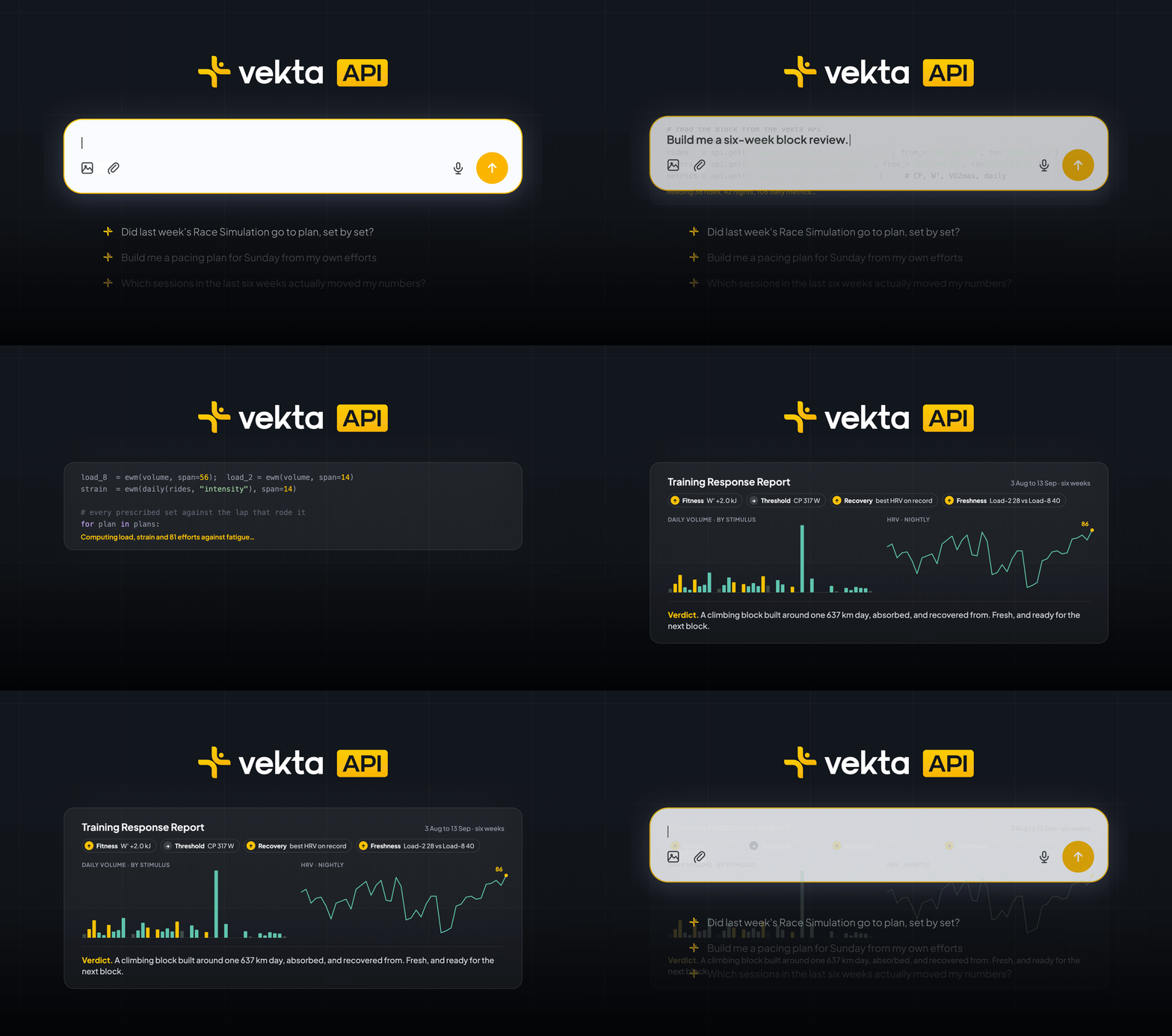
You describe what you want in plain English, the assistant writes it, and you end up with something you can open again whenever you need it. A race plan. A report for your athletes. A morning view of everyone you look after. You do not need to know how to code to get one.
Three examples below, which we built in minutes
Training Response Report
Pick a window. A week, a block, a season. It opens with whether the work paid off, and puts the evidence under it. A coach knows what to do next. An athlete gets the review nobody was ever going to write for them.
Coach Command Centre
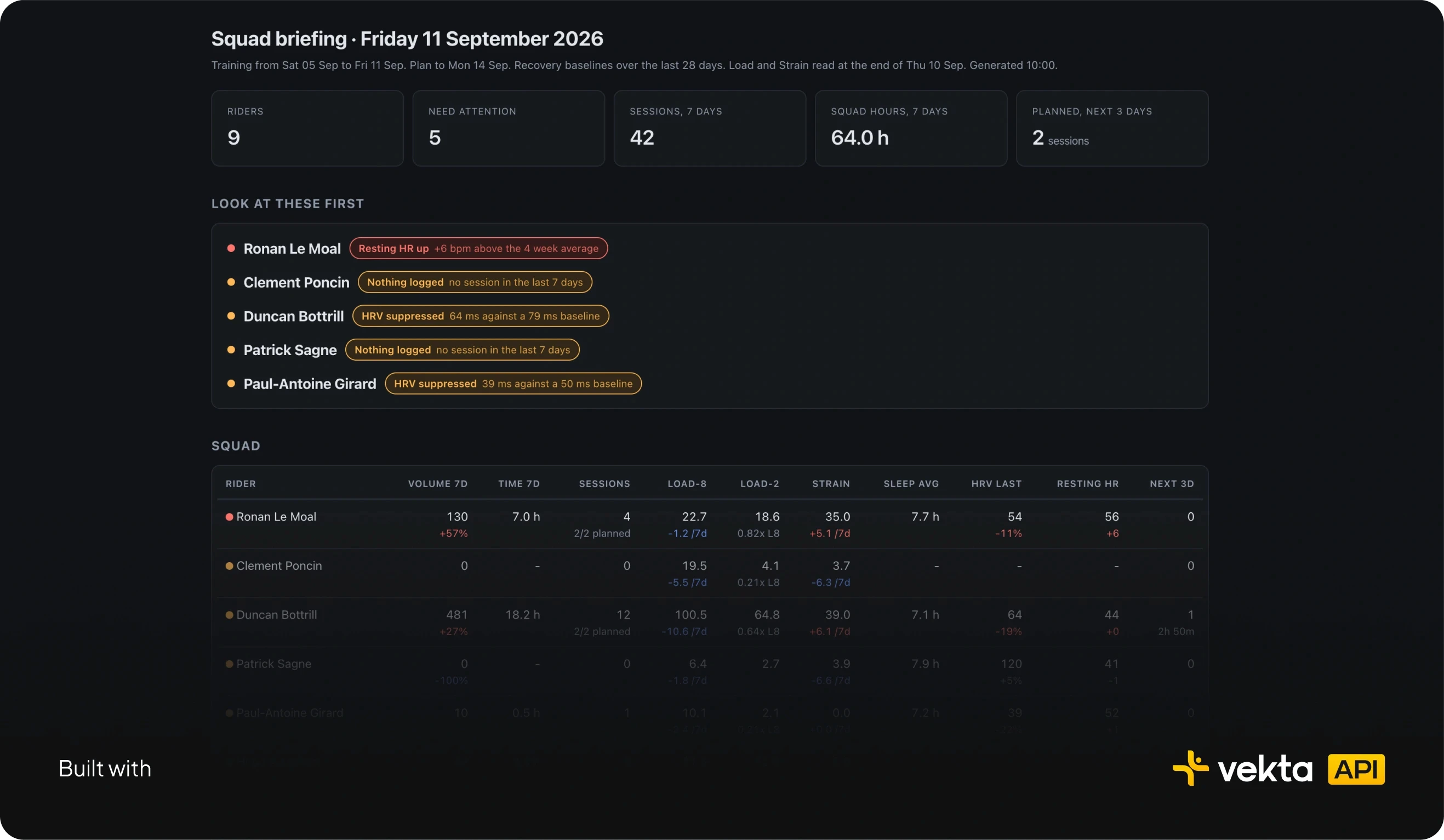
Every athlete you look after, every sport, every morning. It reads all of them before you sit down and tells you who needs you first. The hour you used to spend finding that out, back every day.
Race Day Simulator
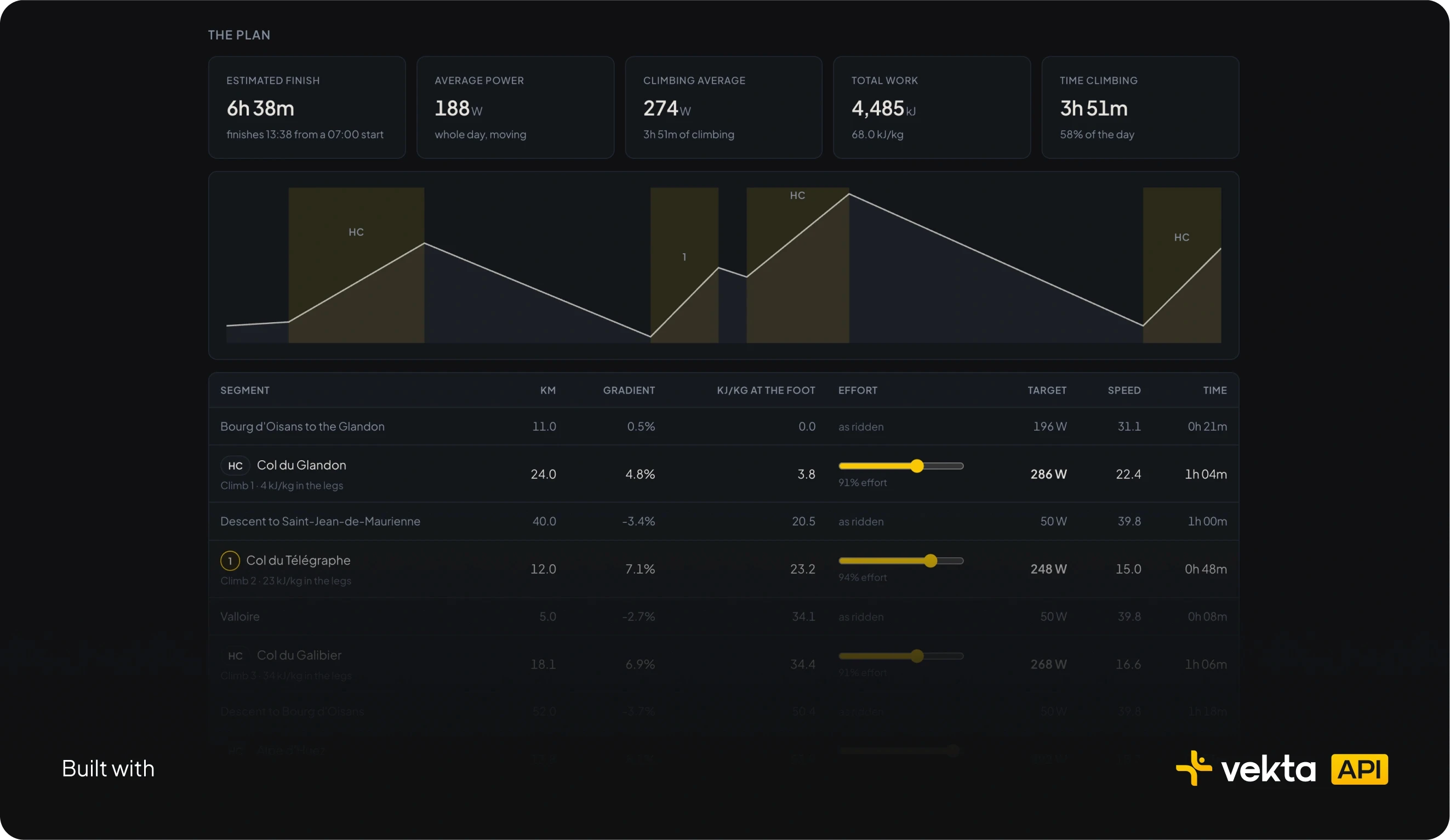
Give it a GPX file and an athlete. It reads where they are today and builds the race: a finish time, every climb, a power target for each one. Most riders start a race guessing what they can hold. This one knows.
Getting Started
Step 1 · Get your key
Email support@joinvekta.com and tell us which Vekta account it’s for. Keys are issued by the team, so there’s nothing to set up first. Same day, usually within hours, and free with any active Vekta subscription. Coaches need at least one athlete in their workspace.
Step 2 · Connect it
Install Claude Code or OpenAI’s Codex, and enter the prompt below to connect your Vekta API key. It walks you through setup and stores the key on your machine. Install once and set it up in a few minutes. After that everything is plain English: it writes and runs the code for you.
"I've got my Vekta API key. Set it up so you can read my training data, keeping the key out of this chat. Start by giving me the command to save it, then check it works and show me my last 7 days of data. Docs: https://api.joinvekta.com/openapi.json"
From there the whole model is open: full history, every second of every ride, every athlete at once. Durability, power duration at any level of fatigue, prescribed against ridden interval by interval. Anything you build can be set to run on a schedule, so a Monday morning report writes itself.
Already write code?
Go straight at the API from Python, R, a notebook or a spreadsheet. The full specification is at https://api.joinvekta.com/openapi.json. Every endpoint, every field it returns.
Keep your key safe. It reaches your data and your athletes’ data, so treat it like a password. Never shared, never published in code, and tell support immediately if you think it has been exposed. Full setup instructions are in the Vekta API support guide.
Need help getting set up? Email support
What Comes Next
Everything above works today. The current setup is deliberately short term, built to get the API to the people who want it now rather than the people who want it polished.
Next, the API writes. Today it only reads. Next it builds plans, reviews athletes, and handles the work that currently means going back into the app yourself.
Then a Vekta MCP server. One connection, made once, from inside the assistant itself. No key to hand over, nothing to install, and no setup on your machine. That means Vekta working directly inside Claude and ChatGPT in a browser. Everything described above, available to anyone who has never opened a terminal in their life.
Ask it a question now. Give it a job later.
The Barrier Is Gone
For as long as endurance sport has been measured properly, the depth of analysis available to a coach and athlete has been a function of budget. Not curiosity, not need, not how well someone understood their own training. Budget, and the building full of people that budget buys.
Vekta was built on the belief that performance shouldn't be limited by geography, background or access. The model was always meant to serve the coach and the athlete, not the platform.
A performance department used to be a building full of people. Now it is a key and a question.
The Vekta API is available now for all coaches and self-coached athletes.
Request your key or start your 14-day free trial
Ask what an athlete can actually hold after 1,200 kilojoules rather than fresh. Run a readiness pass across nine athletes before breakfast and know which two need your attention. Trace which sessions in a six week block moved the needle and which ones cost more than they returned.
None of this is exotic. It is what a WorldTour performance department does on an ordinary Tuesday. What it takes is a building full of people: an analyst who writes code, a sports scientist who knows which question is worth asking, and the budget that carries them. Which is why every coach outside that short list of teams has been running on instinct plus whatever the interface would agree to show them.
The Vekta API is live today, and it is available to any coach or athlete with a Vekta subscription.
Every ride still feeds the model. What changes today is what you can do with it. Ask it anything you have ever wanted to ask about an athlete and get an answer in seconds. Build the system you have always wanted and never had the means to make. Find the things in your own data that nobody has been able to look for yet.
Work that used to take a performance department now takes a question.
What Does the Vekta API Unlock?
This is not a data export. Exports give you rows, and rows are the easy part. What the Vekta API returns is the modelled layer: the same interpreted data the platform itself runs on. Ten endpoints. Nine of them read, and the one that writes sends an athlete an invitation.
Sessions
More than forty summary fields per activity, covering power, normalised power, heart rate, cadence, temperature, elevation, work in kilojoules, calories, RPE and how the athlete said they felt. Alongside them sit Vekta Volume and Intensity, the dominant training stimulus Vekta classified for that session, and an AI-generated summary of what happened.
Efforts, already read
Laps come back Vekta-classified, each stamped with an intensity label and, where Vekta detected one, a secondary characteristic: maximum, torque, cadence, progressive, intra-recovery, dynamic. Climbs are detected automatically with average and maximum gradient, power per kilo and elevation. Laps and climbs are returned for cycling; pool swims come back as lengths, with stroke type and stroke count. This is the automatic interval detection engine, exposed.
And the raw provider laps arrive alongside the classified ones, unmodelled. You can see the original recording and Vekta's reading of it side by side, which is a level of transparency worth having in a dataset you intend to build on.
Telemetry
Per second streams for any session. Power, heart rate, cadence, speed, altitude, grade, position, temperature, left and right balance, torque, W′ balance and intensity, with core temperature, skin temperature, heat strain, breathing rate, tidal volume, minute ventilation, fluid and sodium loss, and running dynamics for athletes carrying the hardware. A channel is only absent when no sensor recorded it on that ride.
Prescriptions
Fully machine readable, with nested steps and repetition blocks. Targets come back in absolute terms and as a percentage of the athlete's own model, whether the session is prescribed from power, heart rate or pace, along with carbohydrate intake. Once a planned session is paired with what was actually ridden, the prescription carries the activity id. Both halves of coaching, what was asked for and what was done, come from the same place.
Daily physiology
The full history of critical power, W′, D′, VO₂max, max power, critical speed, max and resting heart rate, weight, SpO₂ and body fat. Every value flagged as measured by the athlete or estimated by Vekta, so you always know what is a reading and what is a model.
Sleep
Stages, HRV, resting heart rate and skin temperature measured against the athlete's own baseline, from a connected device.
Notes and events
The calendar context that explains the numbers. Notes carry their type, so a rest day, an illness, a nutrition change or an availability problem arrives labelled rather than buried in free text. Events carry the planned race, its date, distance, elevation and target, and pair to the activity once it has been ridden.
Durability
Every lap and every climb carries workBefore: the kilojoules already completed at the moment that effort began. It changes the nature of what can be asked, because it means every effort in an athlete's history knows how much work preceded it. You stop looking at what an athlete can do and start looking at what an athlete can do under fatigue. Durability stops being a concept you discuss and becomes something you query.
The API is included with every Vekta subscription. There is no separate charge and no plan tier.
Want access to the Vekta API? Request your key or start your 14-day free trial
Most Training APIs Are Not For You
Every training platform asks the same thing of its users. Here is your data. Here is our interpretation of it. Here is the view we think you need. It holds up right until a coach wants something specific, and they always want something specific, because no two coaches are the same and no two athletes are the same.
Training APIs are not new either. The question was always who was allowed through. TrainingPeaks runs a partner API for approved commercial developers and states plainly that it is not available for personal use. Xert and WKO5 have no public API. Intervals.icu does issue keys to individuals, and a large community has been built on it.
Vekta's answer is that the person who should be able to reach an athlete's data is the person who knows the athlete. No company to register. No commercial application to describe. No approval queue.
Start by Asking
Connected to an assistant, the API answers what you would otherwise ask a very patient analyst. Here is what comes back.
For the coach.
Which athlete needs my attention today?
Sleep, HRV, resting heart rate and skin temperature read against each athlete's own baseline rather than a population average, with their notes alongside. You decide what counts as attention and what gets ignored. Including the athletes who need nothing from you at all, which is where the time is actually saved.
Who has completed their sessions this week?
Every prescription carries the activity id it was paired with, so the compliance check that normally means opening every calendar in turn becomes one answer.
Write me her race week report.
Everything the week has actually contained, her current numbers, and how both compare to the last time she went into a race in the shape you wanted. Sessions, prescriptions, notes and physiology pulled in one pass, in whatever form is actually useful to you. A report most coaches have never had the hours to produce.
Did that block work?
Every session in it, with the stimulus, volume and intensity it carried, read against how her physiology moved underneath. Critical power, W′, recovery markers, sleep, and the full power duration curve rebuilt at every level of accumulated work. What comes back is which sessions moved which numbers, and which ones moved nothing at all.
One key reaches every athlete in every workspace, sleep and HRV included. A readiness pass across everyone you coach is one of the harder things to assemble anywhere else. Here it is a single question.
For the athlete.
What does fatigue actually cost me?
Every power duration at every level of accumulated work, across your entire history. Not a modelled decline curve. The watts you held fresh and the watts you held deep, both recorded.
Am I riding the distribution I think I am?
Every second of a ride measured against your current critical power, which is how a supposedly steady endurance ride turns out to have spent two hours at tempo and above.
Is my W′ recovering between efforts?
The W′ balance stream tracks your anaerobic reserve second by second. A session can feel brutal and never touch it.
Which sessions actually moved my critical power?
Because CP is re-estimated every day, the daily series lies directly against your training and racing, how you absorbed and recovered from it, and the adaptations that followed.
Then Ask It to Build
Ask and you get an answer. Ask it to build and you get the thing you always wished existed. The limits of this have not been found yet. What follows is where to start. Not where it ends.
You describe what you want in plain English, the assistant writes it, and you end up with something you can open again whenever you need it. A race plan. A report for your athletes. A morning view of everyone you look after. You do not need to know how to code to get one.
Three examples below, which we built in minutes
Training Response Report
Pick a window. A week, a block, a season. It opens with whether the work paid off, and puts the evidence under it. A coach knows what to do next. An athlete gets the review nobody was ever going to write for them.
Coach Command Centre
Every athlete you look after, every sport, every morning. It reads all of them before you sit down and tells you who needs you first. The hour you used to spend finding that out, back every day.
Race Day Simulator
Give it a GPX file and an athlete. It reads where they are today and builds the race: a finish time, every climb, a power target for each one. Most riders start a race guessing what they can hold. This one knows.
Getting Started
Step 1 · Get your key
Email support@joinvekta.com and tell us which Vekta account it’s for. Keys are issued by the team, so there’s nothing to set up first. Same day, usually within hours, and free with any active Vekta subscription. Coaches need at least one athlete in their workspace.
Step 2 · Connect it
Install Claude Code or OpenAI’s Codex, and enter the prompt below to connect your Vekta API key. It walks you through setup and stores the key on your machine. Install once and set it up in a few minutes. After that everything is plain English: it writes and runs the code for you.
"I've got my Vekta API key. Set it up so you can read my training data, keeping the key out of this chat. Start by giving me the command to save it, then check it works and show me my last 7 days of data. Docs: https://api.joinvekta.com/openapi.json"
From there the whole model is open: full history, every second of every ride, every athlete at once. Durability, power duration at any level of fatigue, prescribed against ridden interval by interval. Anything you build can be set to run on a schedule, so a Monday morning report writes itself.
Already write code?
Go straight at the API from Python, R, a notebook or a spreadsheet. The full specification is at https://api.joinvekta.com/openapi.json. Every endpoint, every field it returns.
Keep your key safe. It reaches your data and your athletes’ data, so treat it like a password. Never shared, never published in code, and tell support immediately if you think it has been exposed. Full setup instructions are in the Vekta API support guide.
Need help getting set up? Email support
What Comes Next
Everything above works today. The current setup is deliberately short term, built to get the API to the people who want it now rather than the people who want it polished.
Next, the API writes. Today it only reads. Next it builds plans, reviews athletes, and handles the work that currently means going back into the app yourself.
Then a Vekta MCP server. One connection, made once, from inside the assistant itself. No key to hand over, nothing to install, and no setup on your machine. That means Vekta working directly inside Claude and ChatGPT in a browser. Everything described above, available to anyone who has never opened a terminal in their life.
Ask it a question now. Give it a job later.
The Barrier Is Gone
For as long as endurance sport has been measured properly, the depth of analysis available to a coach and athlete has been a function of budget. Not curiosity, not need, not how well someone understood their own training. Budget, and the building full of people that budget buys.
Vekta was built on the belief that performance shouldn't be limited by geography, background or access. The model was always meant to serve the coach and the athlete, not the platform.
A performance department used to be a building full of people. Now it is a key and a question.
The Vekta API is available now for all coaches and self-coached athletes.
Request your key or start your 14-day free trial

Try Vekta free
Put the theory to work
Vekta is where coaches and athletes plan the work, see the numbers, and track what actually changes.
Try Vekta free
Put the theory to work
Vekta is where coaches and athletes plan the work, see the numbers, and track what actually changes.
Frequently asked questions
Frequently asked questions
Brand Director