
Nutrition
Nutrition
Nutrition
5
5
5
min
min
min
Dominic Valerio
Dominic Valerio
Introducing Carbohydrate Recommendations
Introducing Carbohydrate Recommendations
A carbohydrate target for every session, calculated from the athlete's own physiology.
Fuelling has changed. The tools have not.
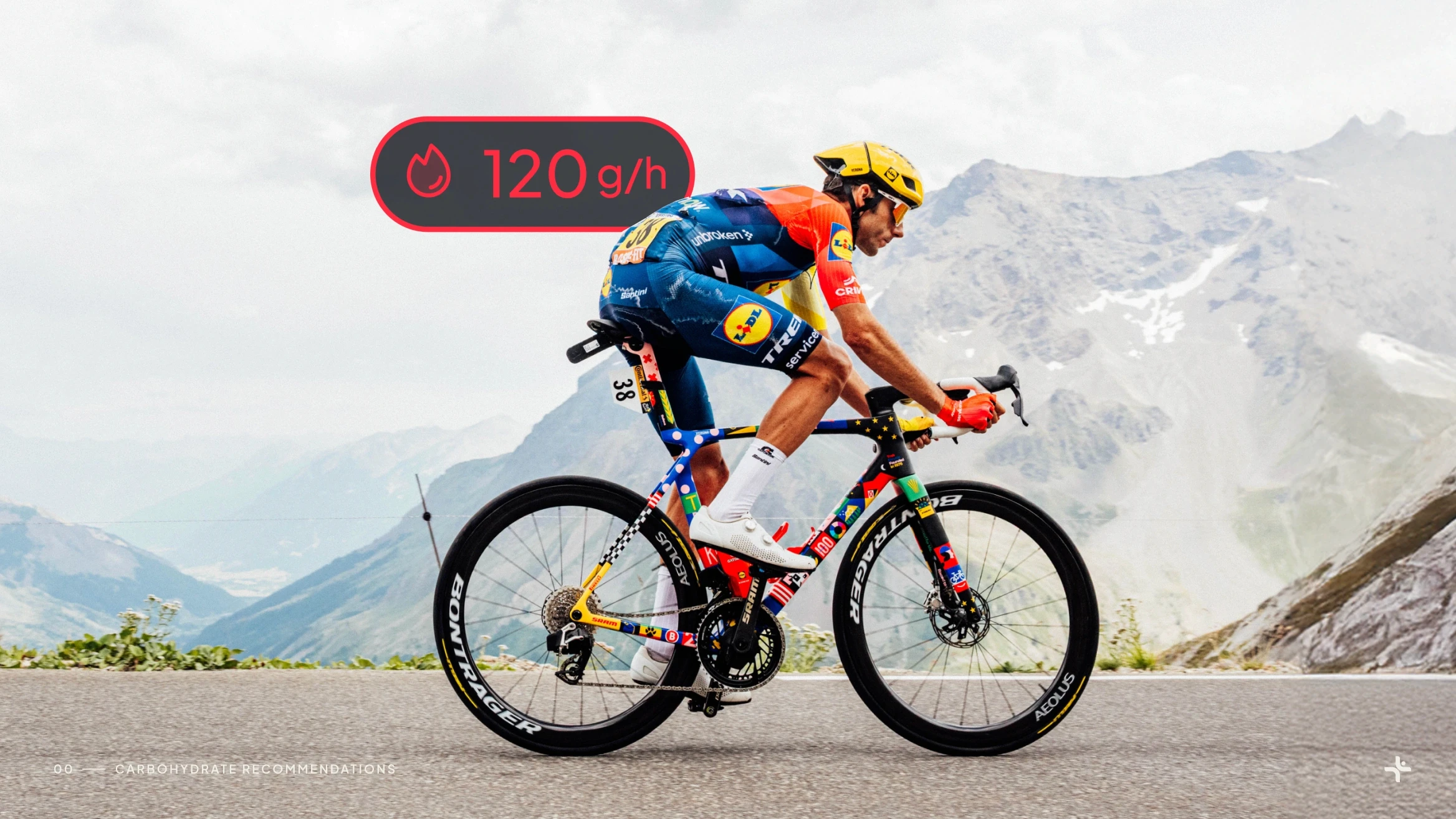
The WorldTour peloton eats roughly twice what it did five years ago. Intakes once treated as an upper limit are now a starting point, and the riders taking 120 grams of carbohydrate an hour on a mountain stage are not outliers. They are the standard.
The performance effect is not marginal. Nutrition is now cited alongside training, equipment and altitude as a primary explanation for how fast modern racing has become.
That shift has not reached most athletes. Below the WorldTour, fuelling is still guided by generic hourly ranges that take no account of the session being ridden or the rider doing it.
The science moved. The tools did not follow.
Training platforms describe what an athlete burned, not what they should eat
The gap is visible across the category.
TrainingPeaks introduced Fueling Insights in 2025, estimating carbohydrate and fat use by reading power data against curves built from laboratory testing. It is careful to state that the figure describes what the muscles oxidised, not what the athlete should consume. Converting one into the other is left to the reader, guided by a rule of thumb published in a blog post.
Others stop in the same place. Xert has estimated substrate use for years; Intervals.icu lets a coach attach a carbohydrate figure to a planned session, but the field arrives empty.
So the athlete is handed an estimate of the past and left to work out the future themselves. The specialist nutrition apps that have grown up alongside these platforms exist precisely because of that gap.
The recommendation is an output of a model that every ride feeds
Vekta approaches it from the other end.
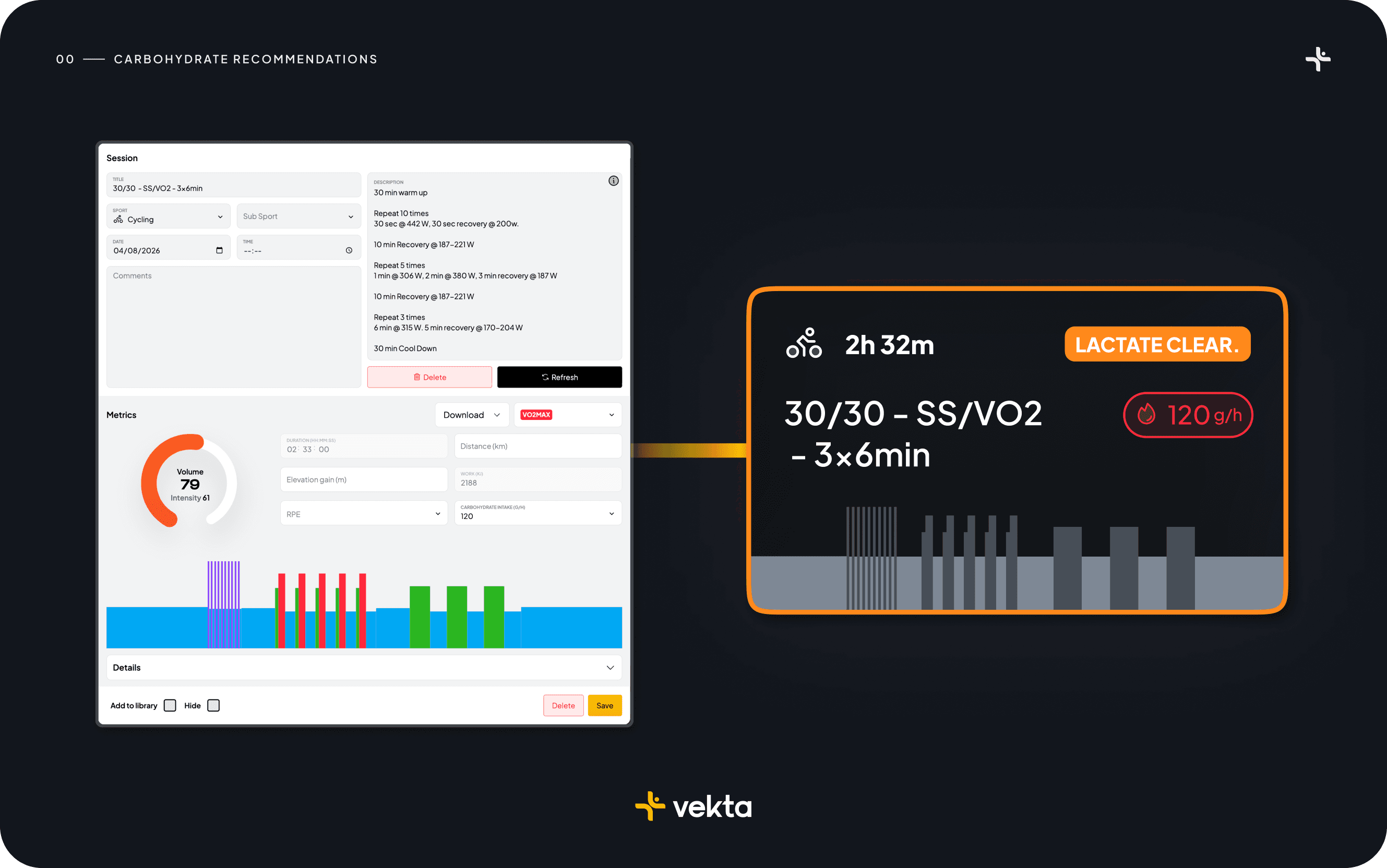
When a session is generated, a carbohydrate target in grams per hour appears alongside it, calculated from two metrics the platform already produces for every workout: Vekta Volume and Vekta Intensity.
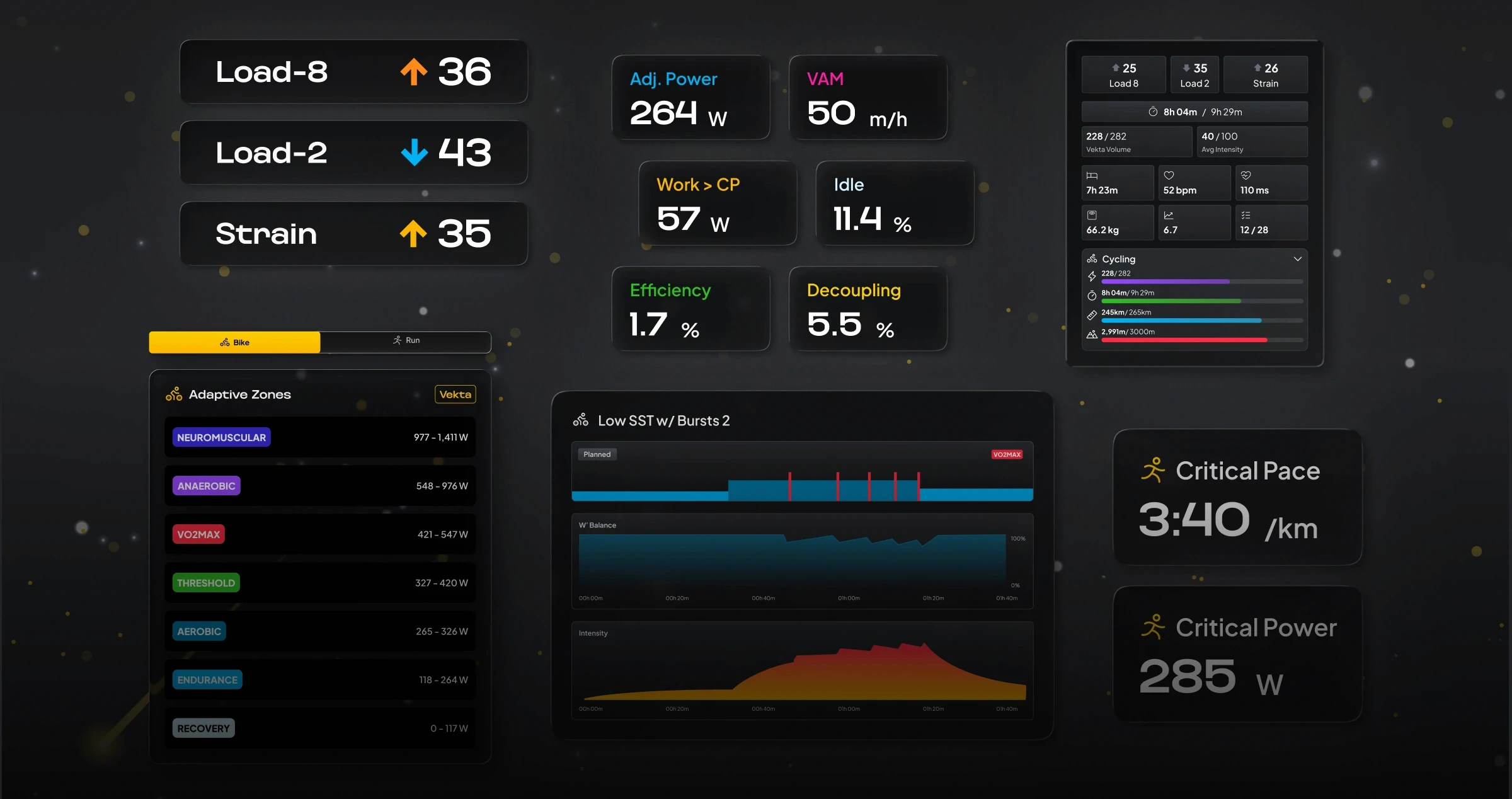
Volume describes the total work demand of the session, normalised for body weight so that 200 watts is not treated identically for a 60kg rider and an 80kg rider. Intensity describes how hard that work is for that specific athlete, calculated continuously through the session and weighted so that efforts above Critical Power (CP) carry disproportionate cost. Intensity scales to the individual's CP, W′ and Pmax, amplifies for repeated intervals, and adjusts for altitude.
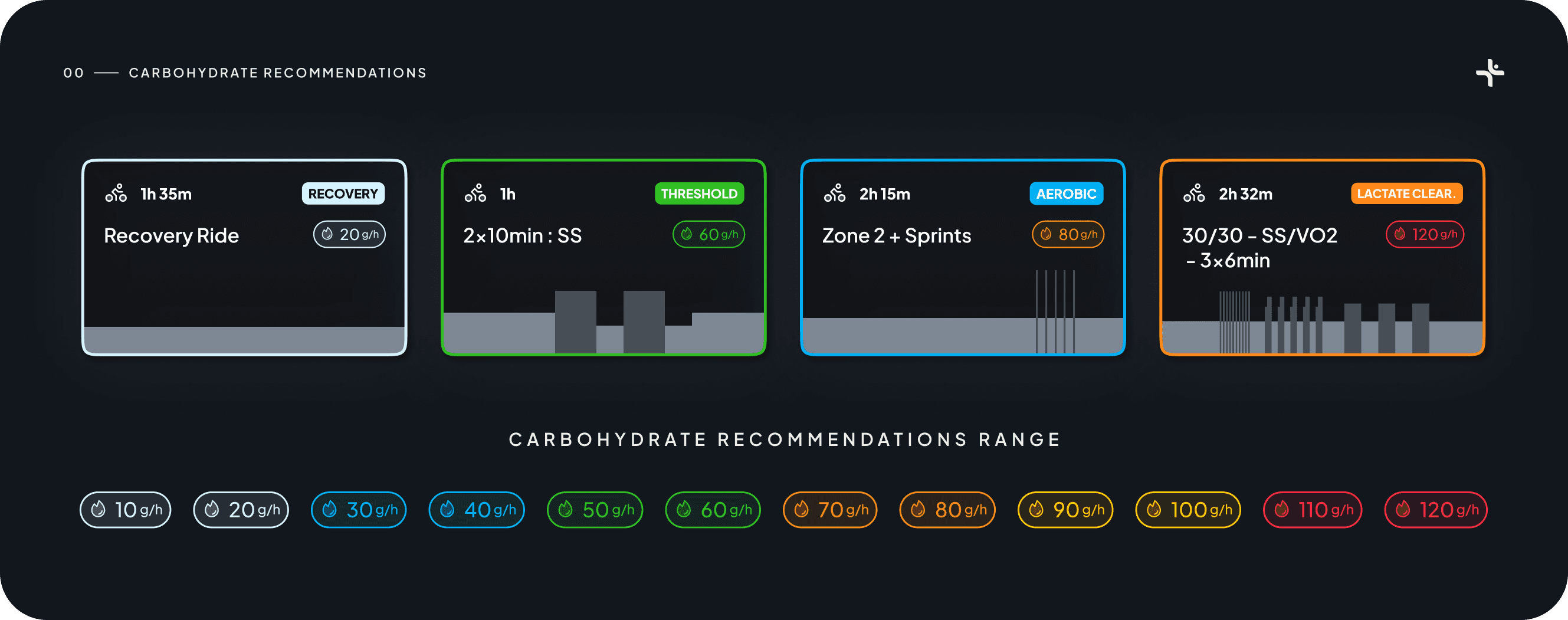
The carbohydrate target is a weighted combination of the two, rounded into practical increments up to a ceiling of 120 g/h.
What matters is where those inputs come from. Vekta updates CP, W′ and Pmax from every ride an athlete uploads. The athlete never has to sit a test to keep those numbers current. Normal training does it. Training zones adapt daily to reflect the most recent performance and recovery data. Volume and Intensity for any given session are then calculated against that current model.
The result is a closed loop. A ride updates the physiological model, the model sets the zones, the zones shape Volume and Intensity, and those two produce the fuelling number. Then the next ride feeds the model again.
For the athlete, that means the target moves as they do. A rider six weeks into a training block has a higher CP than when the block started. Their zones have shifted, so the same prescribed workout now registers a different Intensity, so the carbohydrate recommendation changes.
No test was taken and no setting was changed.
Two riders, one session, two different targets
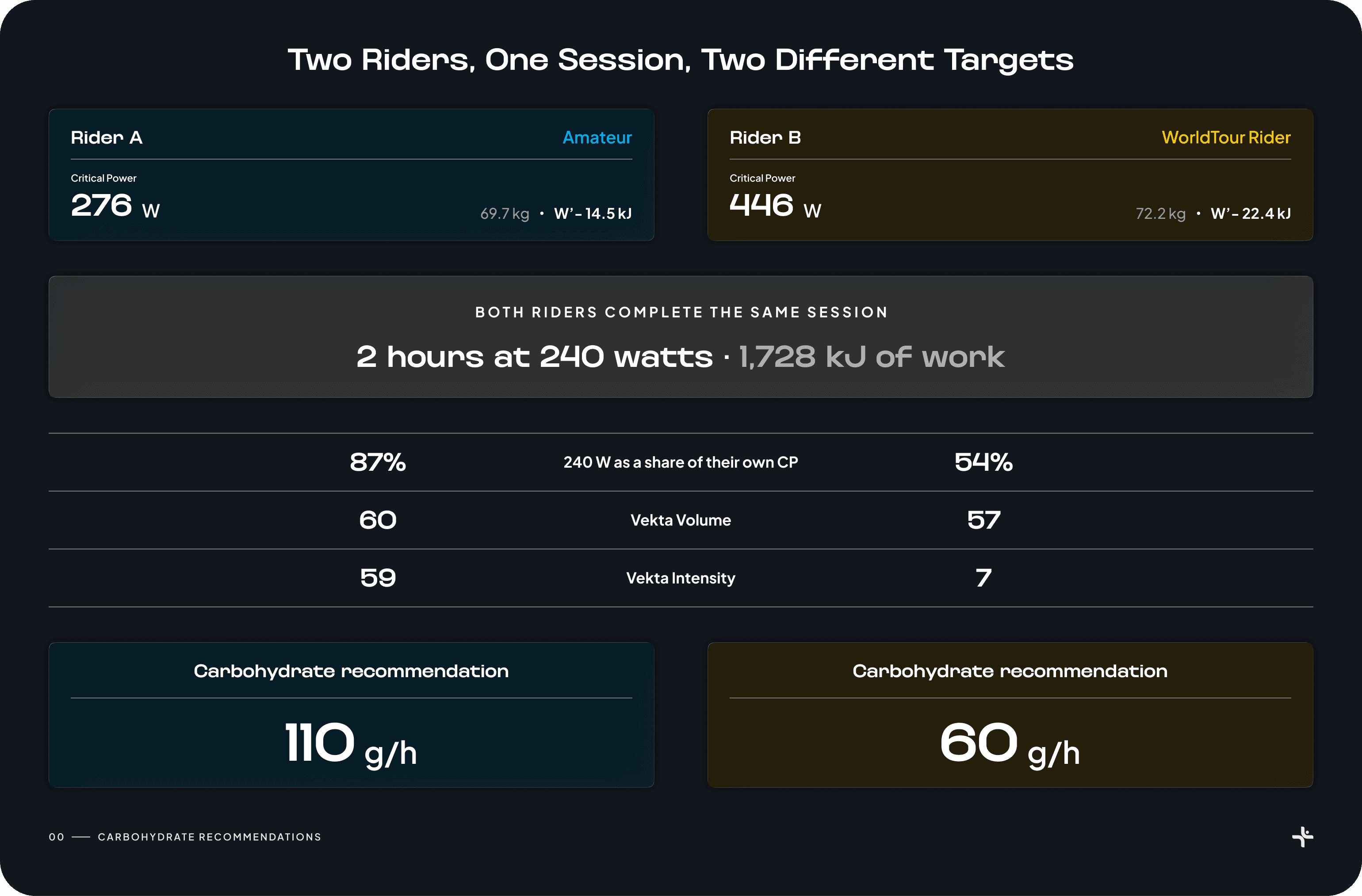
Two riders spend two hours together at 240 watts. Same road, same wheel, same 1,728 kJ of work.
For the professional, with a CP of 446 watts, that is 54 percent of threshold. An endurance day.
For the amateur, with a CP of 276 watts, the same 240 watts is 87 percent of threshold. One of the hardest rides of their week.
Vekta scores the work almost identically for both, at a Volume of 57 and 60. It scores the difficulty at an Intensity of 7 and 59.
The recommendation follows: 60 g/h for the professional, 110 g/h for the amateur.
The difference comes from Intensity. It does not measure watts. It measures what those watts demand of that particular rider. Two hundred and forty watts is just a number. Eighty-seven percent of threshold is a physiological state, and that is what the recommendation responds to.
Because the model updates with every ride, the target keeps pace with the rider's fitness.
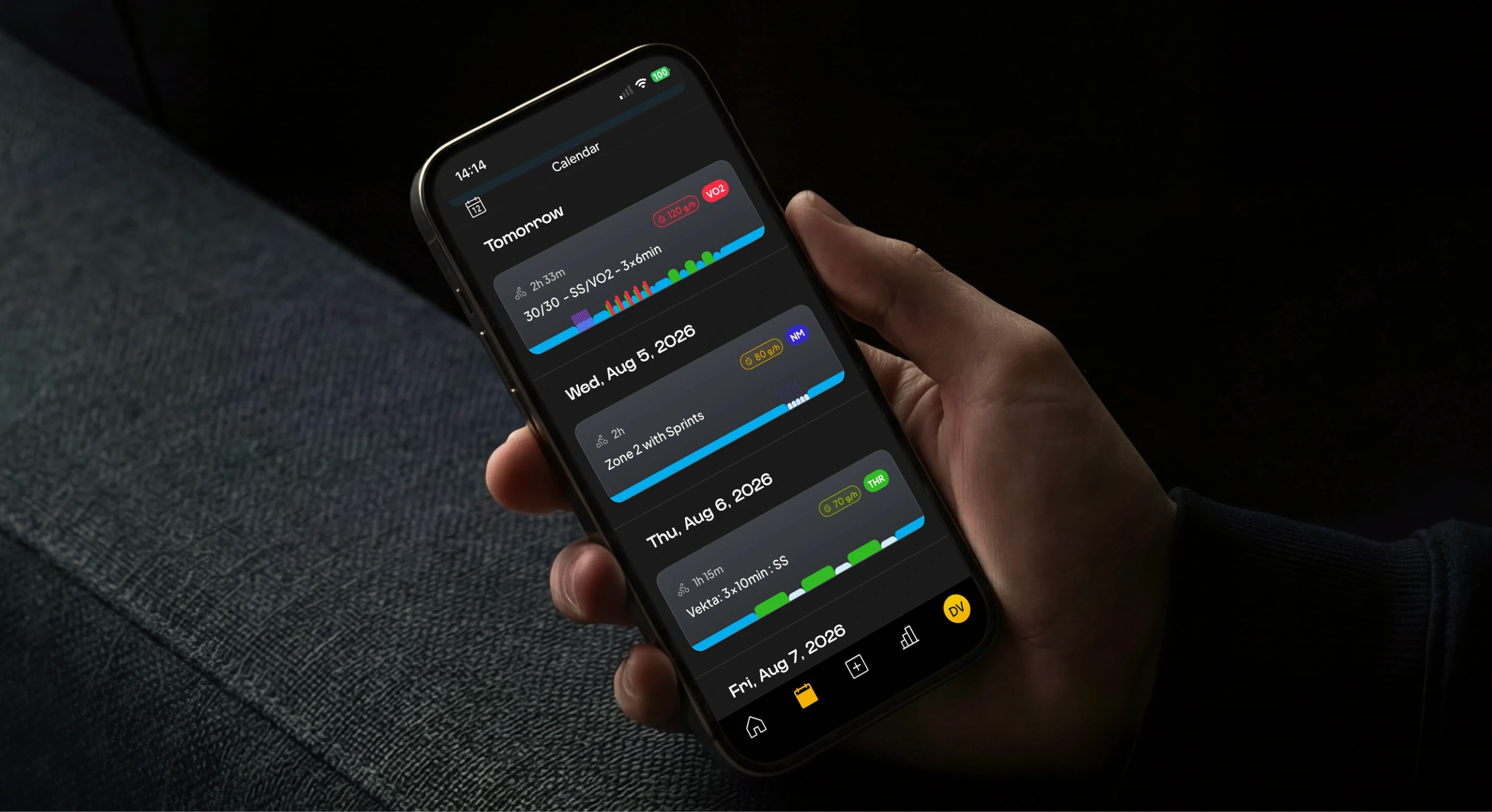
Fuelling now sits inside the same model as everything else
Planning, execution, analysis, wellness and now nutrition run on one performance model rather than five disconnected tools.
That is the point of building it this way. A carbohydrate figure produced by the same system that sets an athlete's zones is not an added feature. It is the same answer, asked in a different way.
Carbohydrate Recommendations are available now for all Vekta athletes and coaches.
Fuelling has changed. The tools have not.
The WorldTour peloton eats roughly twice what it did five years ago. Intakes once treated as an upper limit are now a starting point, and the riders taking 120 grams of carbohydrate an hour on a mountain stage are not outliers. They are the standard.
The performance effect is not marginal. Nutrition is now cited alongside training, equipment and altitude as a primary explanation for how fast modern racing has become.
That shift has not reached most athletes. Below the WorldTour, fuelling is still guided by generic hourly ranges that take no account of the session being ridden or the rider doing it.
The science moved. The tools did not follow.
Training platforms describe what an athlete burned, not what they should eat
The gap is visible across the category.
TrainingPeaks introduced Fueling Insights in 2025, estimating carbohydrate and fat use by reading power data against curves built from laboratory testing. It is careful to state that the figure describes what the muscles oxidised, not what the athlete should consume. Converting one into the other is left to the reader, guided by a rule of thumb published in a blog post.
Others stop in the same place. Xert has estimated substrate use for years; Intervals.icu lets a coach attach a carbohydrate figure to a planned session, but the field arrives empty.
So the athlete is handed an estimate of the past and left to work out the future themselves. The specialist nutrition apps that have grown up alongside these platforms exist precisely because of that gap.
The recommendation is an output of a model that every ride feeds
Vekta approaches it from the other end.
When a session is generated, a carbohydrate target in grams per hour appears alongside it, calculated from two metrics the platform already produces for every workout: Vekta Volume and Vekta Intensity.
Volume describes the total work demand of the session, normalised for body weight so that 200 watts is not treated identically for a 60kg rider and an 80kg rider. Intensity describes how hard that work is for that specific athlete, calculated continuously through the session and weighted so that efforts above Critical Power (CP) carry disproportionate cost. Intensity scales to the individual's CP, W′ and Pmax, amplifies for repeated intervals, and adjusts for altitude.
The carbohydrate target is a weighted combination of the two, rounded into practical increments up to a ceiling of 120 g/h.
What matters is where those inputs come from. Vekta updates CP, W′ and Pmax from every ride an athlete uploads. The athlete never has to sit a test to keep those numbers current. Normal training does it. Training zones adapt daily to reflect the most recent performance and recovery data. Volume and Intensity for any given session are then calculated against that current model.
The result is a closed loop. A ride updates the physiological model, the model sets the zones, the zones shape Volume and Intensity, and those two produce the fuelling number. Then the next ride feeds the model again.
For the athlete, that means the target moves as they do. A rider six weeks into a training block has a higher CP than when the block started. Their zones have shifted, so the same prescribed workout now registers a different Intensity, so the carbohydrate recommendation changes.
No test was taken and no setting was changed.
Two riders, one session, two different targets
Two riders spend two hours together at 240 watts. Same road, same wheel, same 1,728 kJ of work.
For the professional, with a CP of 446 watts, that is 54 percent of threshold. An endurance day.
For the amateur, with a CP of 276 watts, the same 240 watts is 87 percent of threshold. One of the hardest rides of their week.
Vekta scores the work almost identically for both, at a Volume of 57 and 60. It scores the difficulty at an Intensity of 7 and 59.
The recommendation follows: 60 g/h for the professional, 110 g/h for the amateur.
The difference comes from Intensity. It does not measure watts. It measures what those watts demand of that particular rider. Two hundred and forty watts is just a number. Eighty-seven percent of threshold is a physiological state, and that is what the recommendation responds to.
Because the model updates with every ride, the target keeps pace with the rider's fitness.
Fuelling now sits inside the same model as everything else
Planning, execution, analysis, wellness and now nutrition run on one performance model rather than five disconnected tools.
That is the point of building it this way. A carbohydrate figure produced by the same system that sets an athlete's zones is not an added feature. It is the same answer, asked in a different way.
Carbohydrate Recommendations are available now for all Vekta athletes and coaches.
Try Vekta free
Put the theory to work
Vekta is where coaches and athletes plan the work, see the numbers, and track what actually changes.
Try Vekta free
Put the theory to work
Vekta is where coaches and athletes plan the work, see the numbers, and track what actually changes.
Frequently asked questions
Frequently asked questions
Brand Director
80 Features in 9 Months: How We Build at Vekta
Mads Pedersen's Green Jersey Isn't Luck. It's Durability.
