
Key Takeaways
Hill climb training starts with what the climb demands, then trains exactly that. Ed Laverack's target, Porlock Toll Road, is 6.6 km at about 5.5%, roughly 14 minutes of racing, so his key sessions sat between Critical Power and VO2max, such as 8-minute efforts at 105 to 108% of CP.
A summer of long events built the engine the hill climbs drew on. The Marmotte in June and the Etape du Tour in July meant long sub-threshold efforts and durability work, the aerobic base that lets a rider hold a high percentage of Critical Power for a 14-minute climb.
Ed Laverack raised his 12-minute power by 18 W in ten weeks. He rode 388 W in an early August test and 406 W in mid-October (+4.6%), while his body mass fell 3.7 kg, with a moderately high protein intake and strength training twice a week.
Racing most weekends became his top-end training through the hill climb season. From September to late October, Ed raced most Sundays, rode easy on Mondays, kept one or two quality sessions midweek and added intervals after races, because a start line and a stopwatch cannot be recreated in training.
The last ten days before a national title are for arriving fresh, not fitter. Ed cut his volume to around 10 hours a week but kept some intensity, and swapped sessions day to day to find low muscle soreness and the light pedal feeling of a good day.
Ed Laverack paced Porlock to within 2 W of his modelled limit. He averaged 389 W for 14:32 to win the 2026 senior title by 1.2 seconds; Vekta's Critical Power and W′ model gave 391 W for that duration, and his W′ Balance reached zero at the line.
A national hill climb title is decided in seconds and built over years.
On 25 October, Ed Laverack won the British National Hill Climb Championship on Porlock Toll Road by 1.2 seconds, after fourteen and a half minutes of climbing in a cold headwind. It was his second senior title. Ed is a coach and racer: he rode the Marmotte and the Etape du Tour this summer before turning to the hill climbs, and he coaches with Vekta through Laverack Coaching.
In his own words, Ed takes us inside the build: how he matched his training to what Porlock demands, the sessions and tests that lifted his 12-minute power by 18 W, how he tapered, and how he paced a climb won by just over a second. For any coach or athlete building towards one target race, it is a detailed look at what it takes to win a national title.
On Sunday 25 October I rolled off the start line at the bottom of Porlock Toll Road surrounded by some of the best hill climbers in the country. Fourteen and a half minutes later I'd won my second senior British National Hill Climb title, by the narrowest of margins, less than 2 seconds.
Hill climbing is a particularly niche discipline. It's about knowing exactly what the climb demands, training specifically for that, and then trusting the plan, even when the wind and the nerves were telling me to do something else.

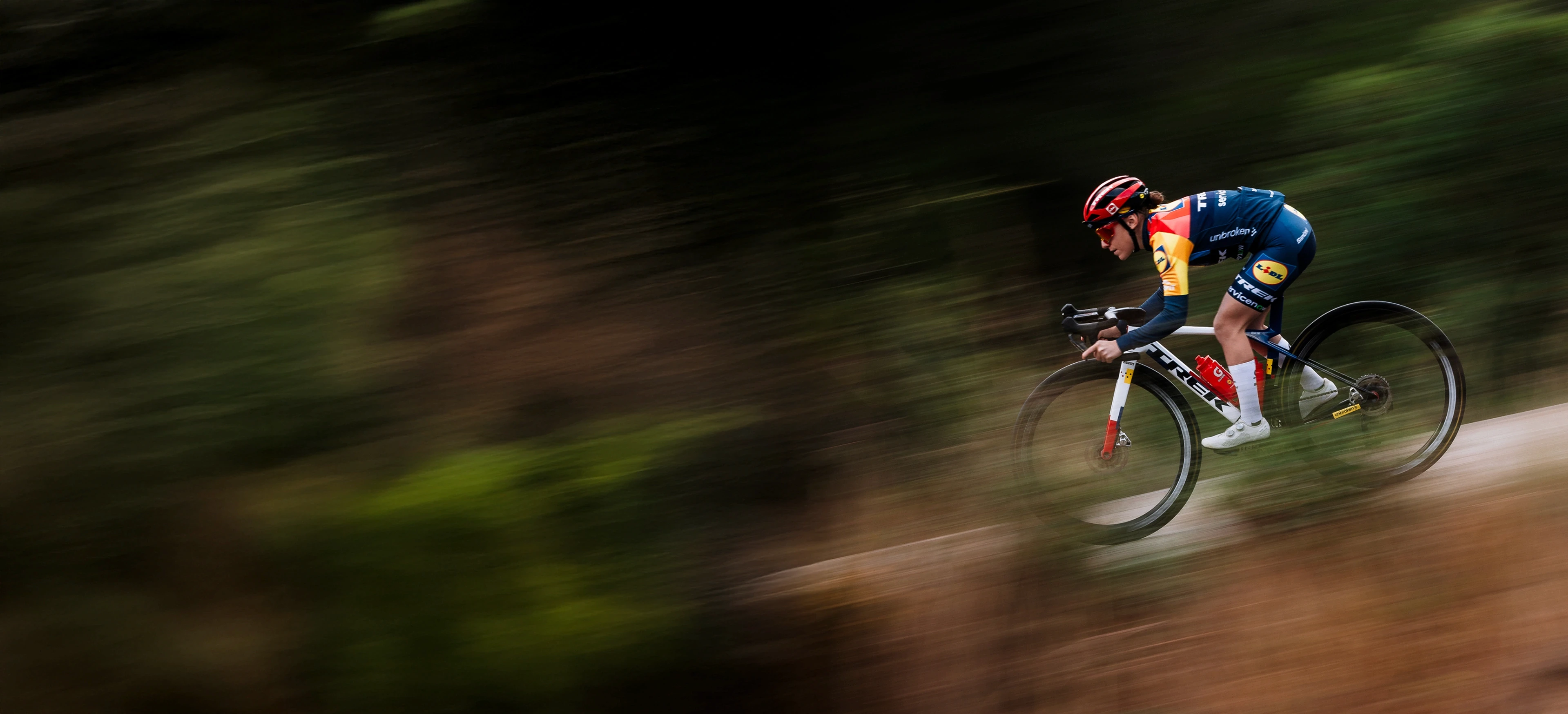
Ed Laverack on Porlock Toll Road at the 2026 British National Hill Climb Championships, on his way to the senior title in 14:32.1.
Knowing What the Hill Wants
Most UK hill climbs are over in three to five minutes, but there is something for everyone. In this case, Porlock Toll Road is 6.6 km at around 5.5%, and it's a climb I've raced up over 7 times. Knowing every section of a climb this length can make all the difference to a race decided by seconds. Porlock is often compared to an alpine climb, featuring 2 hairpins, snaking its way from sea level to 400 m through Exmoor National Park.

Elevation along Porlock Toll Road from 49 m to 415 m over 6.6 km. The steepest section is just past 2 km in the sheltered woodland, the easiest just past 5 km on the exposed moor; the two hairpins come 2.5 km and 3.4 km up.
Building the Engine First
The base for the hill climbs was laid in the summer, chasing very different goals. I rode the Marmotte in June and the Etape du Tour in July, which meant a lot of long, repeated sub-threshold efforts, and big-day durability work. Long aerobic rides and events build the mitochondria and capillaries that let you hold a high percentage of Critical Power (CP), and holding a high percentage of CP is exactly what hill climb races ask of you.
When the preparation switched to Porlock in late July, the longer rides got shorter and more purposeful. A typical week had two quality sessions, one longer ride, and everything else kept easy. Clear distinction between sessions helped me physically and mentally get the best out of myself.

Weekly riding hours from 1 June to 1 November, each bar split into Ed's seven Vekta power zones, with his minutes at or above CP over each week.
Sharpening: The Sessions That Mattered
From around ten weeks out, the training narrowed to a handful of sessions that matched the demands of the climb. At around eight weeks out, I began my hill climb racing campaign by winning a local club event in mid-Wales, followed by a second place by 9 s behind multiple senior hill climb champion Andrew Feather. Over the last 5-6 years we've had some great battles, and the close nature of them has kept me motivated no end.
One of my staple sessions is 4 or 5 × 8-minute efforts at 105–108% of CP. The most race-specific session of the build. It sits in the band between threshold and VO2 max, which is exactly where a 14-minute hill climb lives. It starts manageable and becomes very hard by minute six, which is very close to how Porlock feels.
VO2 Step Down 5x5m was another session I came to “enjoy.” A hard first minute, then four minutes just above CP. This rehearsed the start of the race: getting up to speed quickly without emptying the battery in the first 60 seconds. I'm also someone that gets a lot out of Rønnestad 30/15 blocks, or a 40/20, 60/30 variation. I made sure to enter a few 10 mile time trials in August to get myself familiar with the pacing and effort that riding extended periods at and above CP demand.
These sessions were all about doing the basics right. The number of hard sessions stayed low: two, occasionally three, a week, until the final block. The quality of each one mattered far more than how many reps I could stack up.

Testing, Not Guessing
I tested with a 12-minute all-out effort in early August to set a benchmark. It’s important to be honest with yourself so you can properly hit the numbers in training. In August I managed 388 W for 12 minutes, and a week before the Nationals I did 406 W, an increase of 18 W (+4.6%) in ten weeks, while my body mass fell 3.7 kg.
It's worth noting that I likely maintained muscle mass during this period by maintaining energy balance, a moderately high protein intake and strength training twice a week.
Racing Into Form
The UK hill climb season runs from early September to late October, and I raced most weekends. Those races became my top-end sessions. You can't recreate a start line, a crowd and a stopwatch in training.
The trade-off is recovery. With a race most Sundays, the weeks were built around absorbing them: an easy spin on Monday, one or two proper quality session midweek, and short openers the day before as part of a longer ride. I made a conscious effort to make use of the race days by trying to do some training after the race. I’ll admit it takes a bit of extra motivation to head out again after the race but I never regretted any of those extra intervals.

Six hill climbs from 10 September to 25 October, one row each with distance, elevation, time, average power and his Vekta model's predicted power.
Searching for a Feeling
The 10 days before a national championship isn't the time to get fitter. It's the time to arrive fresh. Volume came down from 16 hours a week to 10 (and 2 hours in the gym), but I kept a little intensity in so my legs didn't go flat.
It was all about finding a feeling. In the last two weeks I had a rough idea what my training will look like, and I'd prioritise certain sessions, but my training often changes on a day by day basis. I’m searching for good sensations and the important aspect for me is feeling good on the bike. Low muscle soreness and the light pedal feeling you sometimes get when you know you are on a good day. I’ll often change and swap my training days during this phase to match my feeling. The same goes for my final big effort in the week before the race: it keeps me sharp but has to be done far enough out to help without accumulating soreness before the race weekend.

Ed Laverack's Scott Addict RC Ultimate, built down to 5.9 kg
Race Day at Porlock
The weather was wild on the day, with a strong, cold headwind forecast. This made the climb a little longer because of how slow we'd be travelling on the exposed moorland at the top. Pacing was more crucial than ever and it was really important to know your limits. Going too hard by 10-20 W for the first 5 minutes could cost you dearly in the final push to the line, so I made a conscious effort to trust my gut on what power I could reliably sustain based on all the recent efforts in training and racing.
The warm-up was the same one I'd use before every race: 15 minutes building through zone 2, 4 minutes around CP, a few minutes recovery and 4 or 5 30/15 microbursts, then a few minutes easy before rolling to the start. Same routine, same timings. On a day when everything else feels unfamiliar, a familiar routine is calming.
What sets the hill climbs apart is the buzz around the finish. You can feel it build as you get further up the climb. The shorter ones can be completely lined with supporters from start to finish, even riders that went off earlier in the day will hang around for hours to wait for the last riders to come through. This year's was no different.
The first half of the race I felt in control: I could think clearly and that's when I knew I hadn't gone out too hard. The first hairpin came after 2.5 km of sheltered woodland and I caught a rider that started 60 seconds ahead of me. The 4 time senior Hill Climb Champion, Andrew Feather, started 30 seconds ahead of me so I knew if I had any chance of matching him I'd need to be able to see him on one of the longer straights in a few kilometres’ time. Hitting the second hairpin I was now into the final 3.5 km of mostly headwind.
This was probably the last time I looked down at my power for the rest of the race because now it was all about going back to that "feeling." If I'd ridden and paced well to here then it was all about getting everything out from here to the top, and gradually winding the effort and RPE up. The final kilometre was a genuine blur: I was squinting so much that I could hardly see. I didn't even have enough energy to stand and sprint to the line, such is the way I'd paced the final 7 minutes to gradually ramp all the way. Thankfully there were catchers on hand to stop me falling off my bike at the finish.
I crossed the line in around 14 minutes 32 seconds, averaging 389 W to claim the senior title by 1.2 s from Andrew Feather and 28.7 s to Rowan Baker in third. A special mention must go to 16-year-old Ezra Bateman, who set the outright fastest time of the day to become Junior British Champion. He was joined by 2 other junior riders that were in the top 10 fastest times on the day. There were terrific battles from fantastic riders across all categories, showcasing the high level of competition at hill climb events. It makes me excited to see what the future has in store for this discipline and the young riders.

The Data Behind the Ride
Ed planned and logged his season in Vekta, and his files tell the same story from the other side.
Paced to the model. On race day, Vekta modelled his Critical Power at 370 W and his W′ at 17.9 kJ. For an effort of fourteen and a half minutes, that model gives 391 W. Ed rode 389 W, 99.6% of it, and his W′ Balance reached zero at the line. For the last 3.5 km he raced on feel, not the screen. The two agreed to within 2 W.

W′ balance through the National Hill Climb on 25 October, drawn as Vekta's W′ Balance card: from 17,915 J at the start, steadily down to 1,191 J below zero at the line in 14:32.1, at 389 W on average.
Work With Ed
Ed is a two-time senior British National Hill Climb Champion who coaches riders through Laverack Coaching, planning and analysing their training in Vekta. His coaching follows the same process that won him this title. He starts from what the target event demands, builds the training around it and tests along the way, so every decision rests on the rider's own data. And he leaves room for how the rider feels when it matters.
Whether your goal for 2027 is a hill climb, a road or gravel Gran Fondo or something else entirely, Ed can build your season around it.
Learn more about Ed and work with him at laverackcoaching.com →
Sources
Data: Ed Laverack's Vekta account, 4 May to 1 Nov 2026, shared with his permission and drawn from the Vekta API.
Photos: Calvinooooo, ezeekwheel, Chris Potts and Ed Laverack
Try Vekta free
Put the theory to work
Vekta is where coaches and athletes plan the work, see the numbers, and track what actually changes.

Laverack Coaching


