
Durability
228 min
High intensity
Two hours of hilly endurance, then two ten-minute climb efforts that move through VO2, tempo and threshold, and three sets of sprints to keep the neuromuscular system sharp for late-race bursts.

Matteo Cigala
Coach, Cigala Cycling

Durability
228 min
High
9 / 10
Advanced
Outdoors
INTERVAL BY INTERVAL
The workout
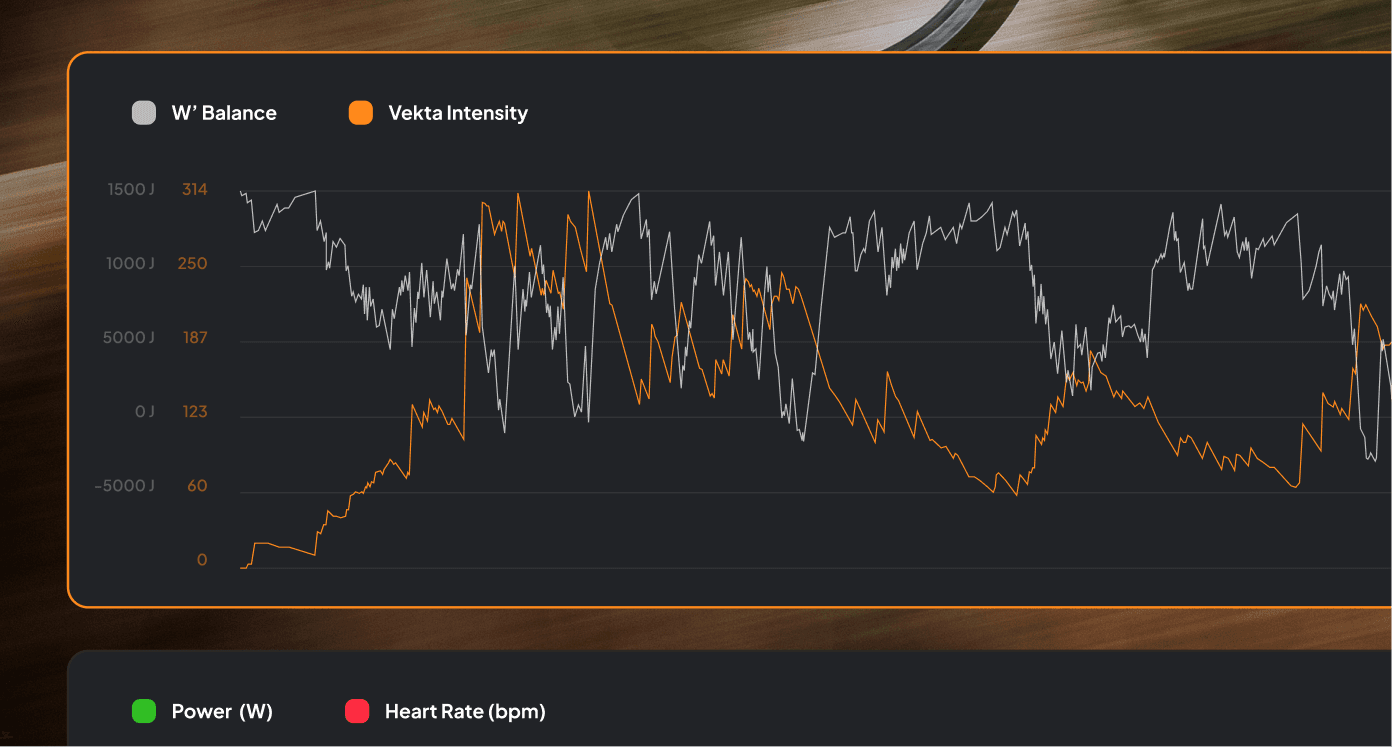
Written as a share of critical power, so it fits every rider. In Vekta it becomes your watts, with the W′ cost shown before you ride.
Matteo Cigala
Why this workout
The breakdown
Inside the workout
Durability, climbing strength and late-race efforts in one long day. Two hours of hilly endurance load the legs; two ten-minute climb efforts add intensity under fatigue; and three sets of sprints at the end replicate late-race bursts and keep the neuromuscular system sharp.
Each climb effort moves through the zones the way a real climb does: two minutes at VO2, three at tempo, four at threshold, one more at VO2. The sprints are ten seconds with two minutes between, three sets of three with five minutes between sets, so they are ridden properly rather than as a tired flourish.
Vekta's classification names each part of the climb efforts and the sprints afterwards, and the durability view shows what the four-minute threshold sections were worth at two hours in compared with fresh. Targets are set against CP; the sprint peaks are read against the rider's own bests.
The long ride of a road-race block, once a week, on hilly terrain. Fuel it as a race.
Durability
Stimulus
Advanced
Workout level
Outdoors
Best ridden
Road,
DISCIPLINE
WHAT YOU NEED
The stimulus
Durability, explained
Hard efforts after hours of work, because races are decided when you are tired.
Long rides with quality placed late: threshold, VO2 or sprint efforts after two to four hours and a set amount of accumulated work. The stimulus is not the interval itself but the state the body is in when it arrives.
Vekta measures durability as your power curve at 0, 10, 20, 30, 40 and 50 kJ/kg of accumulated work: who you are fresh and who you are deep into a race. The gap between the two is where most amateur races and most WorldTour stages are won or lost. It responds to training, and this is the training.
Fuel these sessions properly; the point is to perform late, not to bonk. Expect the late efforts to feel harder than the same effort fresh, and expect that gap to shrink over a block. These are the longest sessions in the library.
Prescribe the late efforts by % of CP and compare the achieved power to the same effort fresh; the durability tab does the comparison across the athlete's history. A widening gap under fatigue is a fuelling or base problem before it is a fitness problem.
The session's late intervals are personalised in Vekta and the ride's kJ/kg is tracked live. Afterwards the durability view places the efforts on the athlete's fatigue-sliced power curve.




Free for coaches. Test with your whole roster during the trial.