
Coach
Coach
Coach
8
8
8
min
min
min
Harrison Hunter
Harrison Hunter
The Signal and the Noise: How Elite Coaches Filter Data
The Signal and the Noise: How Elite Coaches Filter Data
The Signal and the Noise: How Elite Coaches Filter for Success
While the modern training landscape makes it easy to drown in data, top-tier coaches have mastered the art of finding the signal within the noise.
In this piece, Coach Harrison Hunter from Holohan Coaching and Fred's Club breaks down why elite performance is built on a foundation of simplicity. He explains how the right technology allows him to stay focused on the athlete while AI handles the heavy lifting in the background.
1. The Problem: Too Much Information
Somewhere along the way, training became noisy.
Coaches and athletes often believe that reaching a high level requires equally complex training plans: more structure, more metrics, and a constant accumulation of data. The assumption is that complexity signals quality. In reality, it often does the opposite.
Simplicity isn't a lack of intent; it's clarity. While training must be highly specific when preparing for certain disciplines or race demands, specificity doesn't require overcrowding. Sessions don't need endless steps, rules, or targets to be effective.
When training is over-engineered, the purpose of the session gets lost. Athletes start second-guessing good work, questioning whether they executed it “correctly,” or chasing numbers instead of outcomes. In some cases, the focus shifts from improving physically to optimising the session itself.
That's where progress quietly stalls.

2. Simplicity Is Not Anti-Data
Simplicity isn't lazy, and it is not anti-data. It is selective attention.
It's about choosing a few anchor metrics that genuinely reflect the changes you want to see and tracking them consistently over time. Done well, this allows coaches and athletes to ignore the noise without ignoring reality.
The nuance lies in knowing what to pay attention to, and when. Not every metric needs to be monitored all the time. Different phases, athletes, and goals demand different signals. Clarity comes from understanding what matters in the moment, rather than reacting to everything that can be measured.
When attention is focused, data becomes supportive rather than distracting. It becomes a tool that reinforces good training, not one that complicates it.
3. What Actually Matters (Most of the Time)
When you strip training back to its essentials, the foundations of physiological improvement are remarkably consistent.
First: load consistency over time. Adaptation doesn't come from individual sessions, but from weeks and months of repeatable work. The ability to train regularly, without unnecessary interruptions, is far more predictive of progress than any single high-performing file.
Second: intensity distribution. Most endurance performance is built by spending the majority of time at lower intensities, with smaller, deliberate doses of harder work layered on top. When intensity is applied with intent rather than frequency, it supports development instead of undermining it.
Third: fatigue as a whole. Daily freshness scores or isolated metrics rarely tell the full story. Fatigue accumulates through training load, life stress, sleep, travel, and mental pressure. Looking at trends over time, rather than reacting to day-to-day fluctuations, allows for better decisions and more resilient athletes.
Finally: subjective feedback. How an athlete feels, how sessions are perceived, and how motivation changes are not secondary to objective data. They are first-class information. When subjective feedback is valued alongside numbers, patterns become clearer and decisions become more human.
Most of the time, these pillars are enough. When they are respected, training becomes simpler, more sustainable, and ultimately more effective.
4. Where AI Fits (and Where It Doesn’t)
AI is a powerful tool for simplifying data, not replacing judgment. At its best, it acts as a pattern-spotter, helping to connect the dots across weeks and months of training rather than drawing conclusions from isolated sessions.
By surfacing meaningful trends, AI provides context that supports better decisions while leaving the final judgment where it belongs: with the coach and the athlete.
A good example of this is how Vekta automatically identifies and categorises key efforts within a session. Rather than manually searching through files to find where the work actually happened, Vekta's AI highlights meaningful intervals. This allows coaches and athletes to focus on intent and execution rather than administration.
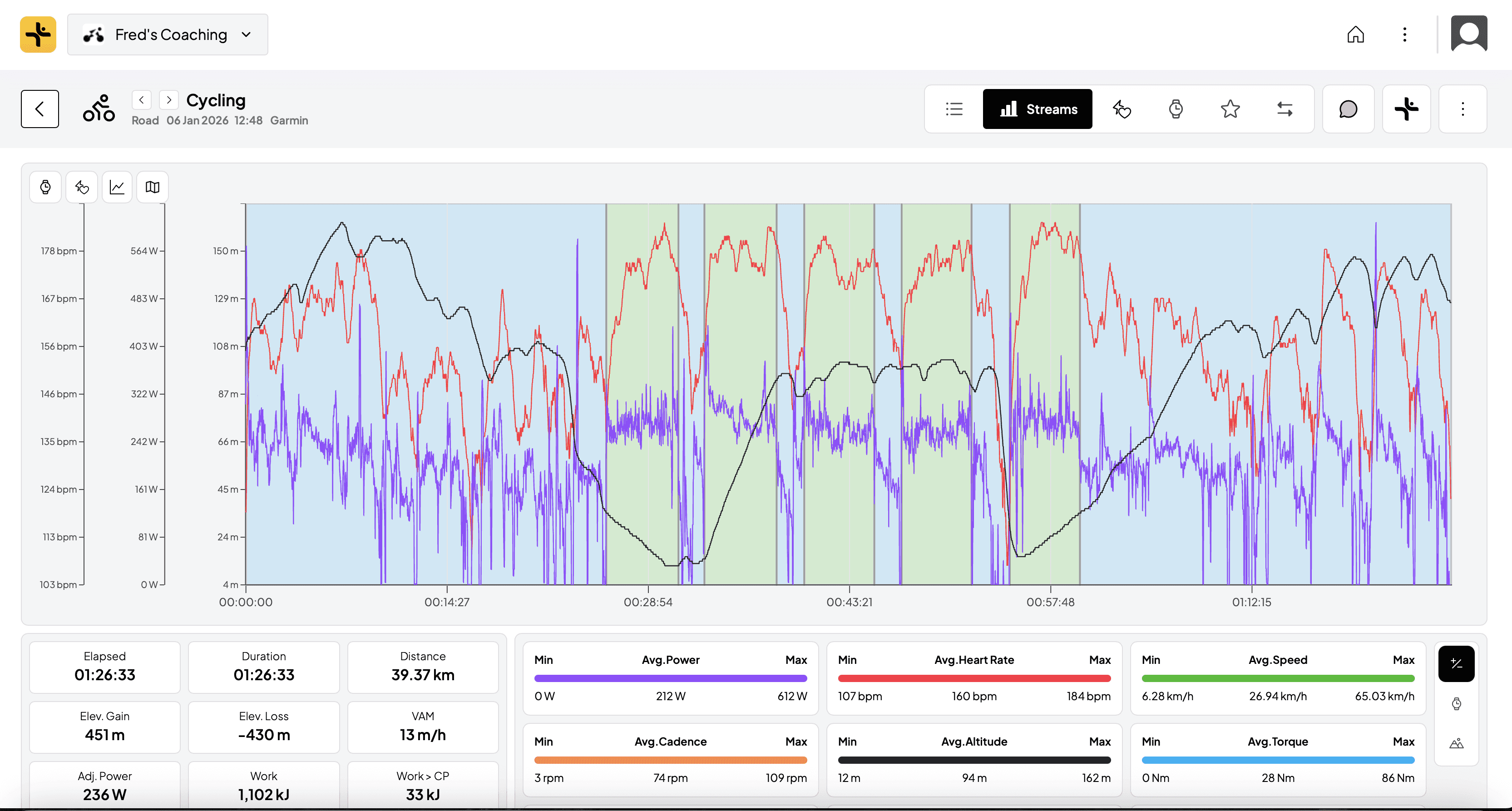
Similarly, Vekta's ability to compare current sessions or races against relevant historical efforts provides instant context. Instead of reacting to isolated numbers, athletes can see how today's work fits into a longer performance narrative: what's improving, what's holding steady, and what's changing over time.
When AI is used effectively, it removes much of the admin by organising data and highlighting what is worth paying attention to. This allows coaching to stay human, with the science working quietly in the background. That balance is key to maintaining strong coach–athlete relationships and supporting sustainable progress.
It also improves the quality of conversations. By presenting information clearly and focusing attention on what actually matters, AI helps athletes understand the intent behind their training. When athletes can see progress, recognise patterns, and trust the process, commitment and motivation follow naturally.
Used this way, AI doesn't complicate coaching; it simplifies it.

5. Athlete at the Centre
Simplicity starts with keeping the athlete at the centre of the process.
This has always been my coaching philosophy. When decisions are made with the athlete first, rather than the data, the platform, or the plan, things tend to stay clearer, healthier, and more sustainable.
When athletes understand the process and feel involved in it, they are far more likely to commit to the work. That buy-in matters. Athletes who trust the plan train with more consistency, more confidence, and less friction. Over time, that consistency is what drives meaningful improvements in physical performance.
Simple plans aren't limiting; they are enabling. Better clarity leads to better adherence, and better adherence leads to better outcomes.
Closing Thought
When coaches keep athletes clear on what is required of them and why, training becomes healthier, more sustainable, and far more enjoyable.
Confidence builds consistency, and consistency is what allows athletes to improve while staying connected to the sport for the long term.
The Signal and the Noise: How Elite Coaches Filter for Success
While the modern training landscape makes it easy to drown in data, top-tier coaches have mastered the art of finding the signal within the noise.
In this piece, Coach Harrison Hunter from Holohan Coaching and Fred's Club breaks down why elite performance is built on a foundation of simplicity. He explains how the right technology allows him to stay focused on the athlete while AI handles the heavy lifting in the background.
1. The Problem: Too Much Information
Somewhere along the way, training became noisy.
Coaches and athletes often believe that reaching a high level requires equally complex training plans: more structure, more metrics, and a constant accumulation of data. The assumption is that complexity signals quality. In reality, it often does the opposite.
Simplicity isn't a lack of intent; it's clarity. While training must be highly specific when preparing for certain disciplines or race demands, specificity doesn't require overcrowding. Sessions don't need endless steps, rules, or targets to be effective.
When training is over-engineered, the purpose of the session gets lost. Athletes start second-guessing good work, questioning whether they executed it “correctly,” or chasing numbers instead of outcomes. In some cases, the focus shifts from improving physically to optimising the session itself.
That's where progress quietly stalls.
2. Simplicity Is Not Anti-Data
Simplicity isn't lazy, and it is not anti-data. It is selective attention.
It's about choosing a few anchor metrics that genuinely reflect the changes you want to see and tracking them consistently over time. Done well, this allows coaches and athletes to ignore the noise without ignoring reality.
The nuance lies in knowing what to pay attention to, and when. Not every metric needs to be monitored all the time. Different phases, athletes, and goals demand different signals. Clarity comes from understanding what matters in the moment, rather than reacting to everything that can be measured.
When attention is focused, data becomes supportive rather than distracting. It becomes a tool that reinforces good training, not one that complicates it.
3. What Actually Matters (Most of the Time)
When you strip training back to its essentials, the foundations of physiological improvement are remarkably consistent.
First: load consistency over time. Adaptation doesn't come from individual sessions, but from weeks and months of repeatable work. The ability to train regularly, without unnecessary interruptions, is far more predictive of progress than any single high-performing file.
Second: intensity distribution. Most endurance performance is built by spending the majority of time at lower intensities, with smaller, deliberate doses of harder work layered on top. When intensity is applied with intent rather than frequency, it supports development instead of undermining it.
Third: fatigue as a whole. Daily freshness scores or isolated metrics rarely tell the full story. Fatigue accumulates through training load, life stress, sleep, travel, and mental pressure. Looking at trends over time, rather than reacting to day-to-day fluctuations, allows for better decisions and more resilient athletes.
Finally: subjective feedback. How an athlete feels, how sessions are perceived, and how motivation changes are not secondary to objective data. They are first-class information. When subjective feedback is valued alongside numbers, patterns become clearer and decisions become more human.
Most of the time, these pillars are enough. When they are respected, training becomes simpler, more sustainable, and ultimately more effective.
4. Where AI Fits (and Where It Doesn’t)
AI is a powerful tool for simplifying data, not replacing judgment. At its best, it acts as a pattern-spotter, helping to connect the dots across weeks and months of training rather than drawing conclusions from isolated sessions.
By surfacing meaningful trends, AI provides context that supports better decisions while leaving the final judgment where it belongs: with the coach and the athlete.
A good example of this is how Vekta automatically identifies and categorises key efforts within a session. Rather than manually searching through files to find where the work actually happened, Vekta's AI highlights meaningful intervals. This allows coaches and athletes to focus on intent and execution rather than administration.
Similarly, Vekta's ability to compare current sessions or races against relevant historical efforts provides instant context. Instead of reacting to isolated numbers, athletes can see how today's work fits into a longer performance narrative: what's improving, what's holding steady, and what's changing over time.
When AI is used effectively, it removes much of the admin by organising data and highlighting what is worth paying attention to. This allows coaching to stay human, with the science working quietly in the background. That balance is key to maintaining strong coach–athlete relationships and supporting sustainable progress.
It also improves the quality of conversations. By presenting information clearly and focusing attention on what actually matters, AI helps athletes understand the intent behind their training. When athletes can see progress, recognise patterns, and trust the process, commitment and motivation follow naturally.
Used this way, AI doesn't complicate coaching; it simplifies it.
5. Athlete at the Centre
Simplicity starts with keeping the athlete at the centre of the process.
This has always been my coaching philosophy. When decisions are made with the athlete first, rather than the data, the platform, or the plan, things tend to stay clearer, healthier, and more sustainable.
When athletes understand the process and feel involved in it, they are far more likely to commit to the work. That buy-in matters. Athletes who trust the plan train with more consistency, more confidence, and less friction. Over time, that consistency is what drives meaningful improvements in physical performance.
Simple plans aren't limiting; they are enabling. Better clarity leads to better adherence, and better adherence leads to better outcomes.
Closing Thought
When coaches keep athletes clear on what is required of them and why, training becomes healthier, more sustainable, and far more enjoyable.
Confidence builds consistency, and consistency is what allows athletes to improve while staying connected to the sport for the long term.

Try Vekta free
Put the theory to work
Vekta is where coaches and athletes plan the work, see the numbers, and track what actually changes.
Try Vekta free
Put the theory to work
Vekta is where coaches and athletes plan the work, see the numbers, and track what actually changes.
Frequently asked questions
Frequently asked questions
Fred's Club
Why Critical Pace is Replacing the Guesswork of Running


How Vekta Uses AI to Make You a More Effective Coach
