
Performance Science
Performance Science
Performance Science
10
10
10
min
min
min
Sarah Laverty
Sarah Laverty
Why Critical Pace is Replacing the Guesswork of Running
Why Critical Pace is Replacing the Guesswork of Running
The world of running is at an inflection point. We are standing on the cusp of a shift toward precision performance, adopting a framework that has already been refined and proven within professional cycling.
Until now, running performance has been limited by the lack of a precise way to prescribe and monitor evolving fitness. While cyclists began speaking the language of high-performance science and performance models, the running world remained tethered to arbitrary paces with little grounding in an athlete's unique physiology.
Even the most progressive coaches were forced to try a strategy and then wait six weeks for a race result to see if it actually worked.
It was, for the most part, guesswork. It was a constrained, broken feedback loop; by the time you realised a training block wasn't working, the season was already over.
Without a precise way to prescribe training for a specific intended stimulus, potential was missed and athletes were frequently burned out in the process.
But the tide is turning. Data is catching up, and the opportunity to be an early adopter is now. To unlock an athlete's potential, science must be the guide. It starts with understanding the defining metric of modern performance: Critical Pace.
What is Critical Pace? (The Science of the "Red Line")
Most runners run "hard" too often. We oscillate between burning ourselves out and getting injured, only to start the cycle over once we heal. At best, we plateau; at worst, we are chronically overtrained because we do not actually know how hard we should be training for the best results.
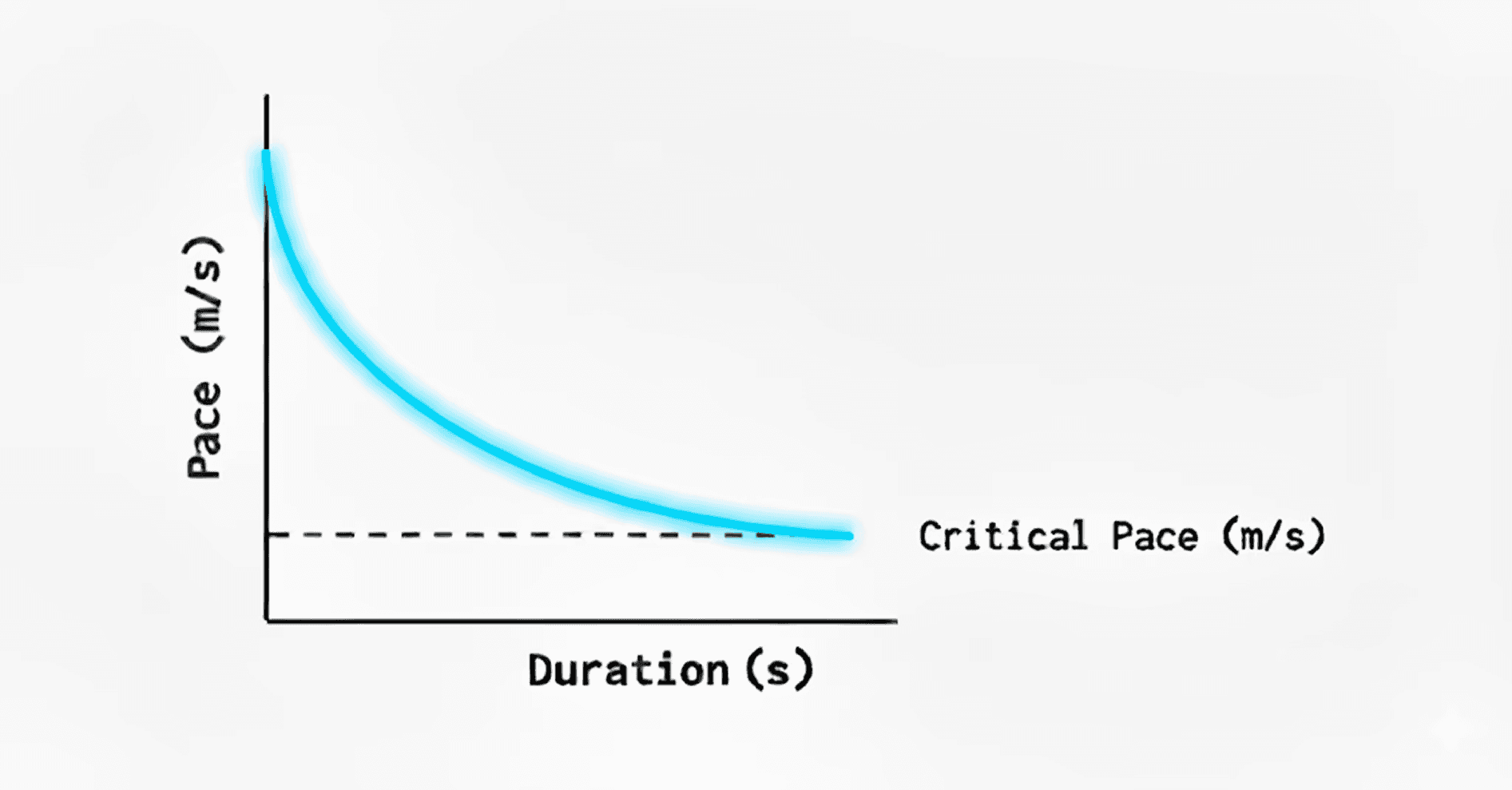
In exercise physiology, Critical Pace (CP) is the precise boundary between sustainable and unsustainable effort. It is your metabolic 'red line', the point where your body shifts from a stable state to a ticking clock. The relationship between your pace and how long you can hold it follows a well-defined hyperbolic curve, meaning as the pace increases even slightly above CP, the duration you can maintain that pace decreases dramatically.

What is happening physiologically?
When you run below CP, your body is in a metabolic steady state. Your muscles are clearing lactate as fast as they produce it. However, once you cross that CP boundary, everything changes. Your oxygen consumption and blood lactate no longer stabilise. You are no longer "cruising," you are on a one-way flight toward exhaustion.
In reality, you will know you have gone beyond CP when you start wishing your fitter training partner would stop asking you questions. Your breathing transitions from a rhythmic, conversational flow to a focused, laboured effort. It is not a sprint, but it demands your total attention to maintain. CP is the highest pace you can sustain while keeping your metabolic systems in a stable steady state.
[Tool: Calculate Your Critical Pace]
Curious where your red line is? Use our Critical Pace Calculator to estimate your CP.
What race distance does it represent?
For most runners: CP is usually a pace you can hold for approximately 30 to 45 minutes.
Elite athletes: Many pros have such efficient aerobic engines that they can hold their CP for up to 60 minutes.
By identifying this boundary, we can define precisely how hard you should run for a desired training stimulus.
Why CP is Critical to Purposeful Training
Without knowing your CP, your training lacks precision. You are essentially shooting in the dark. By building your training around your individual CP, you gain:
Energy System Specificity: You know exactly how to improve the specific systems you need for race day. No more “junk miles” that leave you tired but not faster.
Purpose Driven Sessions: When building workouts with CP, every interval has a clear “why.” You aren't just running; you are targeting specific adaptations.
Better Results: When you start training with precision and stop forcing yourself to keep up with “training partners” whose thresholds don't match yours, you finally get the reward your hard work deserves.
How to Determine Your CP
To find your CP, we need to map your Pace-Duration Curve. This curve represents the mathematical relationship between intensity (pace) and the duration you can hold that pace. As you increase the pace, the duration you can hold that pace drops, eventually flattening out at a pace you can sustain for a significant period: your Critical Pace.
1. Lab Testing
The gold standard. You run on a treadmill at increasing speeds while a coach or clinician measures blood lactate or gas exchange. This identifies the maximal lactate steady state, which is the point where your body can no longer clear the metabolic byproducts of exercise as fast as they are created.
2. Field Testing
If you cannot get to a lab, you can determine these metrics yourself. While Vekta will soon automate this process in the background for you, you can currently find your numbers by following the protocol below.
You can use the Vekta Critical Pace Calculator to plug in your 2, 5, and 12-minute results and get your CP and D'. Manually enter these metrics in Vekta to get your personalised training zones and build Critical Pace based workouts instantly with Vekta’s AI Workout Builder.
1. The Test Durations
You should perform three all-out efforts. The recommended time-based efforts are:
2 minutes
5 minutes
12 minutes
2. Testing Guidelines
Separate Days: Perform each test on a different day with at least 24 hours of rest between them.
Consistent Pacing : Each effort must be maximal, but paced as evenly as possible.
Ideal Conditions : Run on flat, hard-packed surfaces like tarmac and choose a day with minimal wind to ensure your data is clean.
Warm-up adequately: The Critical Pace model assumes your aerobic system kicks in instantly, but in reality, there is a "lag". A thorough warm-up primes your system to minimise this lag and ensures you are ready for a maximal effort.
3. What the Results Tell You
Once you have your distance and time data from these three efforts, there are various online calculators where you can simply input your results to get your CP instantly. In theory, these calculators apply a linear distance-time model to draw a 'line of best fit' through your data points. By using three tests instead of two, the model can account for small variations in performance, ensuring your calculated CP is a true reflection of your physiology rather than a one-off testing error.
What CP Tells You About Your Athlete Type

Critical Pace is only one side of the coin. The other half is D' (D-prime), your “Anaerobic Battery”. It represents the finite distance you can cover once you cross above your Critical Pace.
Physiologically, D' is an indication of your anaerobic abilities, but it also depends on factors such as your VO2max, your neuromuscular ability to recruit high-power muscle fibres, how much fuel is stored in the muscles (e.g., glycogen and phosphocreatine), and how well you are able to clear fatiguing metabolites produced through anaerobic metabolism.
Simplistically speaking:
High CP, Low D': You are a "Diesel" engine. You can cruise for a long time with incredible economy, but less of a "kick".
Lower CP, High D': You are explosive. You have a lethal final 400m, but your "cruising speed" is lower.
Can you change your type?
While genetics set the baseline, you can shape your profile with training. As Vekta expands into running, you will be able to see clearly how your CP and D’ are evolving and responding to training.
How to Increase Your CP
Improving your CP is a key pillar of endurance running. Depending on your "training age," there are two main strategies:
Pushing from the Floor: Increasing low intensity volume and “Sweet Spot” work to improve mitochondrial density and capillary beds.
Pulling from the Ceiling: Working at intensities above CP (e.g VO2 max work) to raise your total aerobic ceiling, dragging your CP up along with it.
Seasoned Athletes: Research suggests that experienced runners often have a "stubborn" CP. They often need a focused block of "pulling from the ceiling" to force a new adaptation.
Less Experienced Athletes: Benefit most from a balanced approach, a little bit of both.
How to Increase Your D’
Expanding your D' battery is about improving your kick. There are three primary ways to grow this tank:
Maximal Intensity Sprints: Performing all out efforts (10 to 30 seconds) with full recovery. This targets neuromuscular recruitment and increases the storage of immediate fuel like phosphocreatine in the muscle fibres.
Intermittent Severe Intervals: Intervals in the VO2 max, Anaerobic and Neuromuscular Pace Zones improve metabolic buffering. This trains your body to tolerate and clear the fatiguing metabolites that accumulate when running above your CP.
Strength and Plyometrics: Incorporating heavy resistance training and explosive movements to improve mechanical power. This increases your ability to recruit high power muscle fibres.
The Future of Your Performance
There is a "purity" to the sport of running that many of us love: the Casio watch, the open road, a pair of trainers (or sneakers depending where you are), and the lack of complex gadgets. But “purity” culture shouldn’t come at the cost of neglecting your potential.
If you are tired of hitting the same plateaus and want clear, personalised guidance, you have to keep up with the sports science. The elites are already using these models; there is no reason to leave that advantage to them and a few tech savvy amateurs.
The time to bridge the performance gap is now. By moving away from "guesswork" and toward a purpose driven, CP based program, you unlock a level of purpose and potential you didn't know was possible.
Ready to stop guessing and start knowing your training zones? Try our free Critical Pace calculator today.
Build your balanced program with Vekta. Use our AI Workout Builder to create scientifically anchored sessions in seconds that sync straight to your watch.
Explore the Vekta Roadmap and join the revolution.
References
Jones, A. M., Koppo, K., & Burnley, M. (2003). Effects of prior exercise on metabolic and gas exchange responses to exercise. Sports Medicine, 33(13), 949-971.
Maturana, F. M., Fontana, F. Y., Pogliaghi, S., Passfield, L., & Murias, J. M. (2018). Critical power: How different protocols and models affect its determination. Journal of Science and Medicine in Sport, 21(7), 742-747.
Poole, D. C., Burnley, M., Vanhatalo, A., Rossiter, H. B., & Jones, A. M. (2016). Critical power: an important fatigue threshold in exercise physiology. Medicine and science in sports and exercise, 48(11), 2320.
Simpson, L., & Kordi, M. (2017). Comparison of Critical Power and W′ Derived From 2 or 3 Maximal Tests, International Journal of Sports Physiology and Performance, 12(6), 825-830.
Vanhatalo, A., Jones, A. M., & Burnley, M. (2011). Application of critical power in sport. International journal of sports physiology and performance, 6(1), 128-136.
The world of running is at an inflection point. We are standing on the cusp of a shift toward precision performance, adopting a framework that has already been refined and proven within professional cycling.
Until now, running performance has been limited by the lack of a precise way to prescribe and monitor evolving fitness. While cyclists began speaking the language of high-performance science and performance models, the running world remained tethered to arbitrary paces with little grounding in an athlete's unique physiology.
Even the most progressive coaches were forced to try a strategy and then wait six weeks for a race result to see if it actually worked.
It was, for the most part, guesswork. It was a constrained, broken feedback loop; by the time you realised a training block wasn't working, the season was already over.
Without a precise way to prescribe training for a specific intended stimulus, potential was missed and athletes were frequently burned out in the process.
But the tide is turning. Data is catching up, and the opportunity to be an early adopter is now. To unlock an athlete's potential, science must be the guide. It starts with understanding the defining metric of modern performance: Critical Pace.
What is Critical Pace? (The Science of the "Red Line")
Most runners run "hard" too often. We oscillate between burning ourselves out and getting injured, only to start the cycle over once we heal. At best, we plateau; at worst, we are chronically overtrained because we do not actually know how hard we should be training for the best results.
In exercise physiology, Critical Pace (CP) is the precise boundary between sustainable and unsustainable effort. It is your metabolic 'red line', the point where your body shifts from a stable state to a ticking clock. The relationship between your pace and how long you can hold it follows a well-defined hyperbolic curve, meaning as the pace increases even slightly above CP, the duration you can maintain that pace decreases dramatically.
What is happening physiologically?
When you run below CP, your body is in a metabolic steady state. Your muscles are clearing lactate as fast as they produce it. However, once you cross that CP boundary, everything changes. Your oxygen consumption and blood lactate no longer stabilise. You are no longer "cruising," you are on a one-way flight toward exhaustion.
In reality, you will know you have gone beyond CP when you start wishing your fitter training partner would stop asking you questions. Your breathing transitions from a rhythmic, conversational flow to a focused, laboured effort. It is not a sprint, but it demands your total attention to maintain. CP is the highest pace you can sustain while keeping your metabolic systems in a stable steady state.
[Tool: Calculate Your Critical Pace]
Curious where your red line is? Use our Critical Pace Calculator to estimate your CP.
What race distance does it represent?
For most runners: CP is usually a pace you can hold for approximately 30 to 45 minutes.
Elite athletes: Many pros have such efficient aerobic engines that they can hold their CP for up to 60 minutes.
By identifying this boundary, we can define precisely how hard you should run for a desired training stimulus.
Why CP is Critical to Purposeful Training
Without knowing your CP, your training lacks precision. You are essentially shooting in the dark. By building your training around your individual CP, you gain:
Energy System Specificity: You know exactly how to improve the specific systems you need for race day. No more “junk miles” that leave you tired but not faster.
Purpose Driven Sessions: When building workouts with CP, every interval has a clear “why.” You aren't just running; you are targeting specific adaptations.
Better Results: When you start training with precision and stop forcing yourself to keep up with “training partners” whose thresholds don't match yours, you finally get the reward your hard work deserves.
How to Determine Your CP
To find your CP, we need to map your Pace-Duration Curve. This curve represents the mathematical relationship between intensity (pace) and the duration you can hold that pace. As you increase the pace, the duration you can hold that pace drops, eventually flattening out at a pace you can sustain for a significant period: your Critical Pace.
1. Lab Testing
The gold standard. You run on a treadmill at increasing speeds while a coach or clinician measures blood lactate or gas exchange. This identifies the maximal lactate steady state, which is the point where your body can no longer clear the metabolic byproducts of exercise as fast as they are created.
2. Field Testing
If you cannot get to a lab, you can determine these metrics yourself. While Vekta will soon automate this process in the background for you, you can currently find your numbers by following the protocol below.
You can use the Vekta Critical Pace Calculator to plug in your 2, 5, and 12-minute results and get your CP and D'. Manually enter these metrics in Vekta to get your personalised training zones and build Critical Pace based workouts instantly with Vekta’s AI Workout Builder.
1. The Test Durations
You should perform three all-out efforts. The recommended time-based efforts are:
2 minutes
5 minutes
12 minutes
2. Testing Guidelines
Separate Days: Perform each test on a different day with at least 24 hours of rest between them.
Consistent Pacing : Each effort must be maximal, but paced as evenly as possible.
Ideal Conditions : Run on flat, hard-packed surfaces like tarmac and choose a day with minimal wind to ensure your data is clean.
Warm-up adequately: The Critical Pace model assumes your aerobic system kicks in instantly, but in reality, there is a "lag". A thorough warm-up primes your system to minimise this lag and ensures you are ready for a maximal effort.
3. What the Results Tell You
Once you have your distance and time data from these three efforts, there are various online calculators where you can simply input your results to get your CP instantly. In theory, these calculators apply a linear distance-time model to draw a 'line of best fit' through your data points. By using three tests instead of two, the model can account for small variations in performance, ensuring your calculated CP is a true reflection of your physiology rather than a one-off testing error.
What CP Tells You About Your Athlete Type
Critical Pace is only one side of the coin. The other half is D' (D-prime), your “Anaerobic Battery”. It represents the finite distance you can cover once you cross above your Critical Pace.
Physiologically, D' is an indication of your anaerobic abilities, but it also depends on factors such as your VO2max, your neuromuscular ability to recruit high-power muscle fibres, how much fuel is stored in the muscles (e.g., glycogen and phosphocreatine), and how well you are able to clear fatiguing metabolites produced through anaerobic metabolism.
Simplistically speaking:
High CP, Low D': You are a "Diesel" engine. You can cruise for a long time with incredible economy, but less of a "kick".
Lower CP, High D': You are explosive. You have a lethal final 400m, but your "cruising speed" is lower.
Can you change your type?
While genetics set the baseline, you can shape your profile with training. As Vekta expands into running, you will be able to see clearly how your CP and D’ are evolving and responding to training.
How to Increase Your CP
Improving your CP is a key pillar of endurance running. Depending on your "training age," there are two main strategies:
Pushing from the Floor: Increasing low intensity volume and “Sweet Spot” work to improve mitochondrial density and capillary beds.
Pulling from the Ceiling: Working at intensities above CP (e.g VO2 max work) to raise your total aerobic ceiling, dragging your CP up along with it.
Seasoned Athletes: Research suggests that experienced runners often have a "stubborn" CP. They often need a focused block of "pulling from the ceiling" to force a new adaptation.
Less Experienced Athletes: Benefit most from a balanced approach, a little bit of both.
How to Increase Your D’
Expanding your D' battery is about improving your kick. There are three primary ways to grow this tank:
Maximal Intensity Sprints: Performing all out efforts (10 to 30 seconds) with full recovery. This targets neuromuscular recruitment and increases the storage of immediate fuel like phosphocreatine in the muscle fibres.
Intermittent Severe Intervals: Intervals in the VO2 max, Anaerobic and Neuromuscular Pace Zones improve metabolic buffering. This trains your body to tolerate and clear the fatiguing metabolites that accumulate when running above your CP.
Strength and Plyometrics: Incorporating heavy resistance training and explosive movements to improve mechanical power. This increases your ability to recruit high power muscle fibres.
The Future of Your Performance
There is a "purity" to the sport of running that many of us love: the Casio watch, the open road, a pair of trainers (or sneakers depending where you are), and the lack of complex gadgets. But “purity” culture shouldn’t come at the cost of neglecting your potential.
If you are tired of hitting the same plateaus and want clear, personalised guidance, you have to keep up with the sports science. The elites are already using these models; there is no reason to leave that advantage to them and a few tech savvy amateurs.
The time to bridge the performance gap is now. By moving away from "guesswork" and toward a purpose driven, CP based program, you unlock a level of purpose and potential you didn't know was possible.
Ready to stop guessing and start knowing your training zones? Try our free Critical Pace calculator today.
Build your balanced program with Vekta. Use our AI Workout Builder to create scientifically anchored sessions in seconds that sync straight to your watch.
Explore the Vekta Roadmap and join the revolution.
References
Jones, A. M., Koppo, K., & Burnley, M. (2003). Effects of prior exercise on metabolic and gas exchange responses to exercise. Sports Medicine, 33(13), 949-971.
Maturana, F. M., Fontana, F. Y., Pogliaghi, S., Passfield, L., & Murias, J. M. (2018). Critical power: How different protocols and models affect its determination. Journal of Science and Medicine in Sport, 21(7), 742-747.
Poole, D. C., Burnley, M., Vanhatalo, A., Rossiter, H. B., & Jones, A. M. (2016). Critical power: an important fatigue threshold in exercise physiology. Medicine and science in sports and exercise, 48(11), 2320.
Simpson, L., & Kordi, M. (2017). Comparison of Critical Power and W′ Derived From 2 or 3 Maximal Tests, International Journal of Sports Physiology and Performance, 12(6), 825-830.
Vanhatalo, A., Jones, A. M., & Burnley, M. (2011). Application of critical power in sport. International journal of sports physiology and performance, 6(1), 128-136.

Try Vekta free
Put the theory to work
Vekta is where coaches and athletes plan the work, see the numbers, and track what actually changes.
Try Vekta free
Put the theory to work
Vekta is where coaches and athletes plan the work, see the numbers, and track what actually changes.
Frequently asked questions
Frequently asked questions

Growth and Brand Manager