
Performance Science
Performance Science
Performance Science
6
6
6
min
min
min
Dominic Valerio
Dominic Valerio
ChatGPT vs Vekta
ChatGPT vs Vekta
Can AI Replace Your Cycling Coach? Cycling Weekly Put It to the Test
This article references 'ChatFTP', published in Cycling Weekly and written by elite rider and coach Zach Nehr.
Can artificial intelligence replace a human coach?
It is the question cycling has been circling for years. Cycling Weekly decided to find out properly.
Writer and elite rider Zach Nehr set two cyclists to work on six-week training blocks. One guided entirely by ChatGPT. One by a human coach, augmented by Vekta. Zach evaluated both plans blind at the end, as a neutral party and qualified coach. What he found was not what the headline numbers suggested.
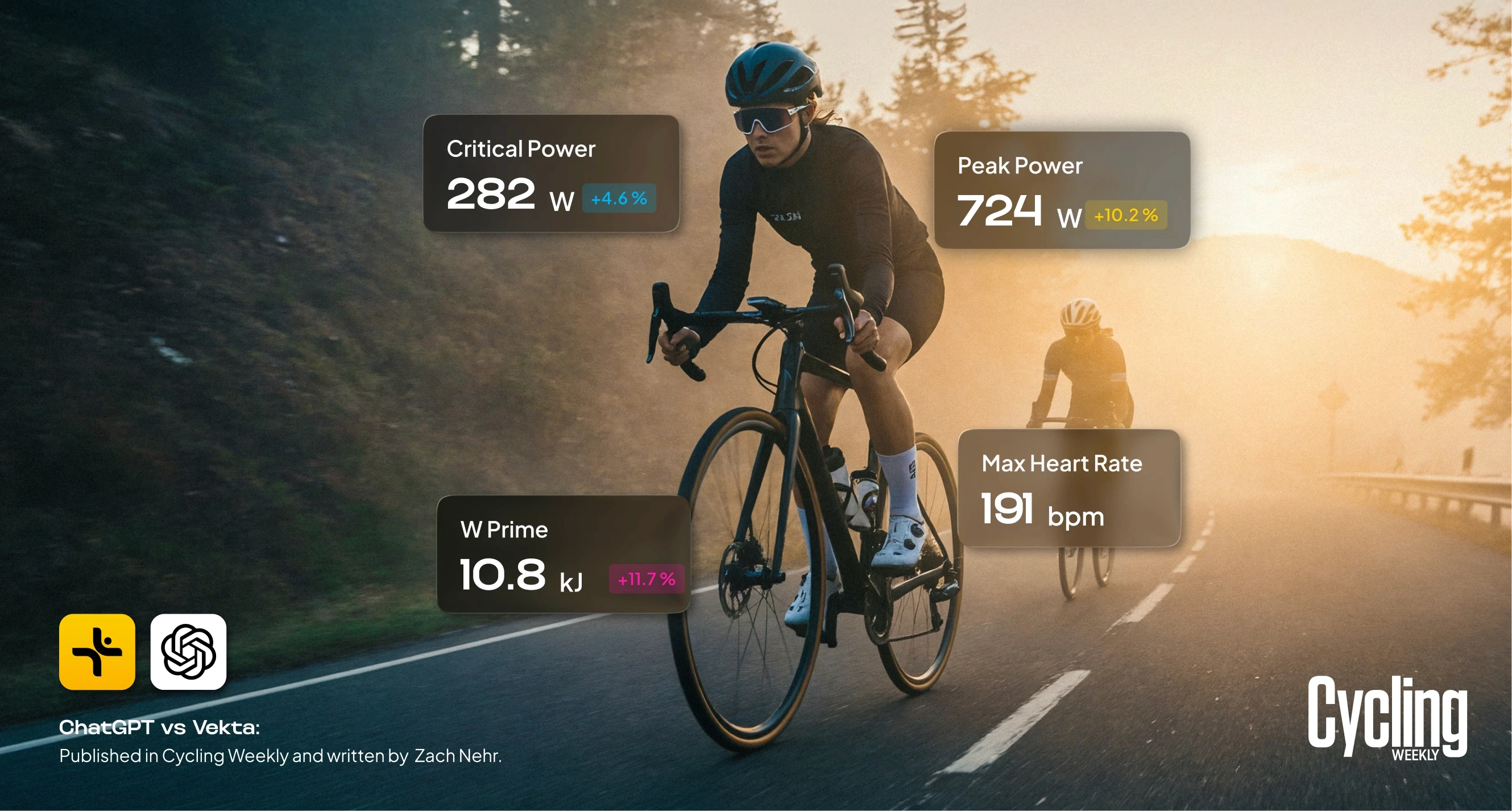
The Experiment
Two riders. Two very different athletes. Two very different approaches.
Rider A was Jeff Herman, 37, a cyclist improving his fitness on a time-crunched schedule, doing group rides each weekend and competing in some of his first long gravel races. He followed a fully AI-generated training plan from ChatGPT, sticking to his usual six to eight hours per week. No coach, no check-ins, no adjustments along the way.
Rider B was Ben Binet, an experienced cyclist in his late thirties, training 12 to 16 hours per week, with a bodybuilding background and years of experience with structured training and nutrition. He was getting married and changing jobs, balancing elite-level training against a hectic life schedule. He worked with Ulisses Abbud, a Miami-based former professional rider, with Vekta providing the analytical layer behind every decision.
Ulisses used Critical Power (CP) and W' throughout, not FTP, with Vekta's data informing every session he prescribed. Vekta's Load and Strain tracking monitored how Ben's body was absorbing load, calculated from thousands of data points. As Zach wrote in the article, this was "something beyond the processing power of a human coach."
Six weeks later, they retested.
The Two Plans
The difference between the approaches is clearest when you see both weekly structures side by side.
Day | Jeff's ChatGPT Plan | Ben's Vekta and Human Coach Plan |
|---|---|---|
Monday | Rest | Rest |
Tuesday | VO2max session | VO2max intervals |
Wednesday | Endurance ride | Sub-LT1 blocks |
Thursday | Sweet-spot or threshold intervals | Threshold intervals |
Friday | Zone 2 ride or Zwift Race | Rest |
Saturday | Group ride | Long endurance ride |
Sunday | Group ride | Semi-long endurance with sweet-spot or threshold intervals to finish |
Jeff's ChatGPT plan: three to five hard sessions per week with no structured recovery day beyond Monday. Ben's plan: hard Tuesday, structured Wednesday and Thursday, a full rest Friday before the weekend's longer work. The difference in design philosophy is visible before either rider turns a pedal.
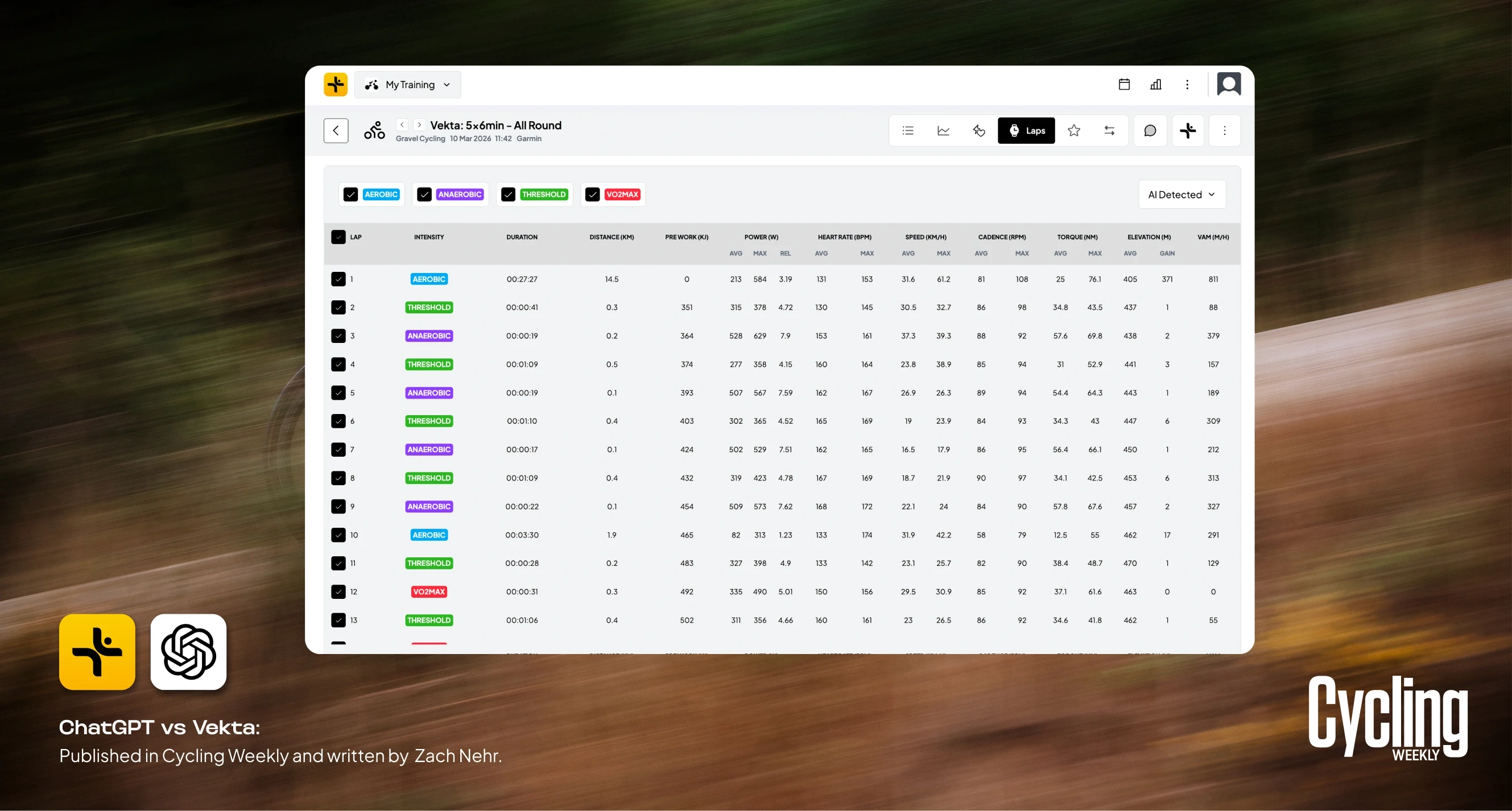
The Results
Rider | Start | Finish | Change |
|---|---|---|---|
Jeff (ChatGPT) | 200W FTP | 227W FTP | +27W / +13.5% |
Ben (Vekta + coach) | 389W FTP | 397W FTP | +8W / +2.1% |
Both riders improved. The story behind those numbers comes later.
AI Is a Bad Boss
ChatGPT handed Jeff a punishing schedule. Three to five interval sessions per week, week after week, with no ability to read fatigue, no sense of what was happening in Jeff's life, and no mechanism to pull back when the load became too much. It simply said: push harder. Every week.
Jeff made it through. His fitness base was sufficient and his calendar was completely clear, no work trips, no holidays, six weeks of rare consistency. But by the end he described feeling "a little frayed." He reflected that the plan had "emphasised short-term FTP increases" and said he was "unsure whether I'd be able to follow the plan long-term."
What was conspicuously missing, Zach observed, was the art of coaching. An algorithm can crunch power, heart rate and sleep data all day long. It cannot connect on a human level. It cannot intuit when it needs to ask:
"How do you feel when you get out of bed this morning? Is often far more valuable than any metric on a chart."
Zach Nehr
Both riders, it turned out, skirted the edges of mental burnout, "trapped by relentless schedules that lacked the flexibility, empathy and nuance required to navigate the unpredictability of real life."
AI, Zach concluded, is better used as a tool than regarded as a boss.
What a Coach and Vekta Saw That an Algorithm Could Not
Ben's experience was different in texture from the first session.
Ulisses prescribed every session using Vekta's CP and W' data as his analytical foundation. Where Jeff's plan pushed hard and kept pushing, Ben's plan was structured around who he actually was: an 80kg rider at nearly 400 watts, managing a life in transition, needing precision rather than aggression. The same platform trusted by seven WorldTour cycling teams gave Ulisses a level of analytical depth no individual coach could match alone. The sessions were detailed, targeted and explained.
"The exact duration and wattage targets for every session helped me progress a lot. Ulisses was very helpful in explaining the idea behind the programme and what we were trying to achieve."
Ben Binet
That last sentence is easy to read past. An algorithm cannot explain the idea behind the programme. It can generate the plan. It cannot give an athlete the understanding and confidence to execute it. The trust, the reasoning, the human connection: those came from Ulisses. The analytical precision came from Vekta. Together they produced something neither could have produced alone.
Ben's plan was better balanced. He enjoyed the block more. He arrived at the end of six weeks in better shape physically and mentally than Jeff, despite starting from a far harder position.
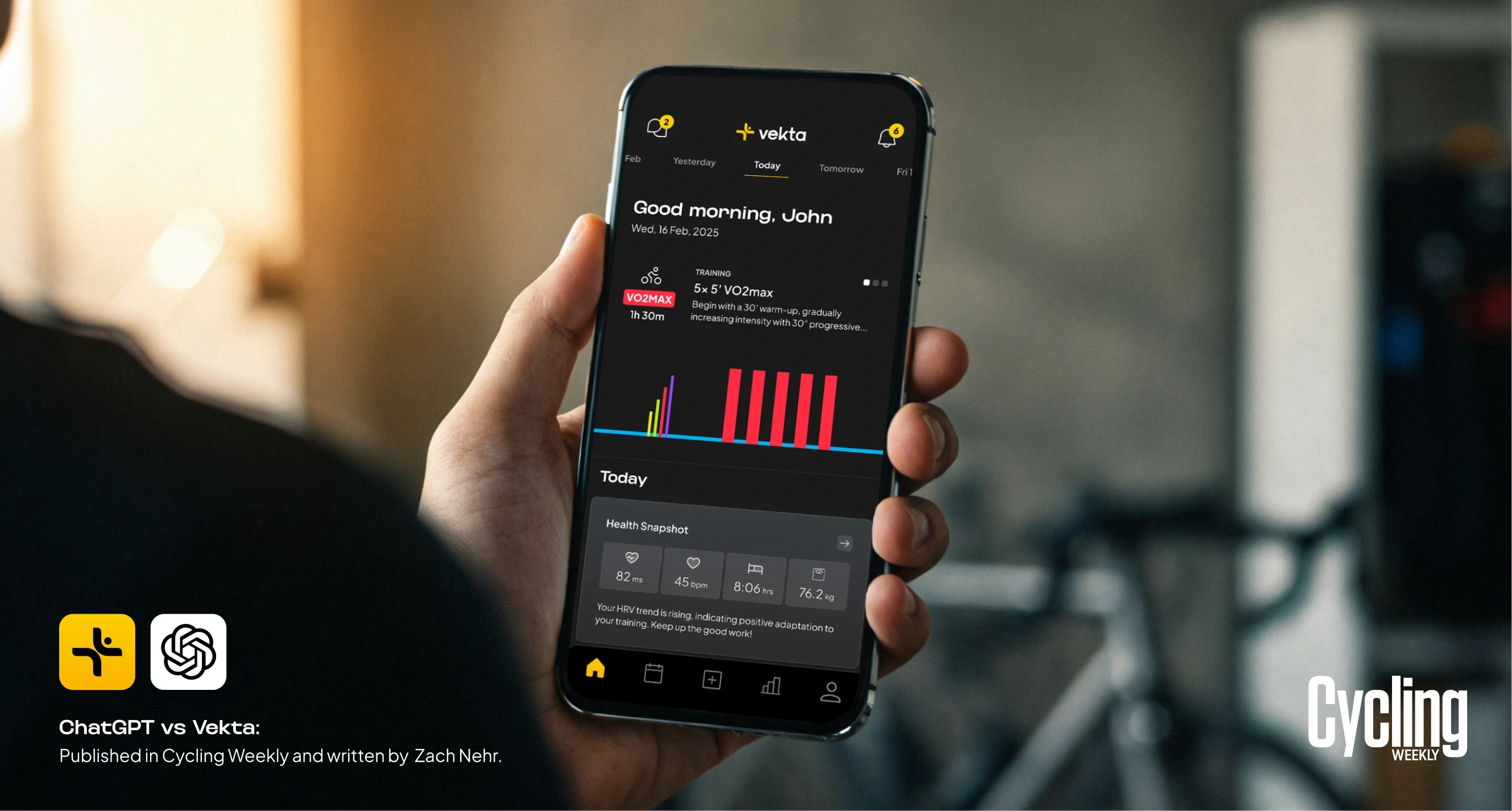
Interpreting the Results
The two riders started from very different physiological baselines. That context is essential before the numbers make sense.
Ulisses explains:
"Jeff started at 200 watts, which leaves much more room for rapid improvement, especially over a short six-week block with consistent structured training. Ben had years of structured training behind him and was already training at a high level. At that point, even a small increase in absolute power is much harder to achieve. The two riders started from a very different physiological baseline."
There is also what the FTP comparison does not capture at all. Vekta tracks Critical Power, not FTP, and recorded a 13% increase in Ben's CP across the six weeks. Ben also lost approximately 1.5kg during the block, making his power-to-weight improvement more significant than the raw wattage figure suggests. His final test was affected by pacing: he pushed 445 watts for the first ten minutes before pulling back. Zach noted that with proper pacing, the result "might well have surpassed the magical 400-watt mark."
The Verdict
Jeff's ChatGPT Plan | Ben's Vekta and Human Coach Plan | |
|---|---|---|
Zach Nehr's verdict | 6/10 | 9/10 |
Pros | Quick, easy, cheap. Functional structure that gets a rider moving and improving | Extremely detailed and personalised. High levels of human interaction with the opportunity for frequent adjustments. Less work for the athlete means more time to focus on their training and recovery. |
Cons | Zero human interaction. Limited feedback and data analysis, and a tendency towards overtraining. Fails to take into account an athlete's daily fatigue, real-world schedule changes, or unexpected | Cost of coach and platform combined. |
The 9/10 versus 6/10 is not just a score. It is the difference between a plan that works for six weeks and one that works for an athlete. ChatGPT optimises for a metric. A human coach backed by Vekta optimises for the person.
His conclusion was unambiguous:
"While AI has a bright and lasting future in the sport, it is currently best used as a tool rather than a boss. The ultimate training formula isn't man versus machine. It is the raw data-crunching power of the algorithm, steered by the irreplaceable intuition of a human coach."
Ben put it differently, and perhaps more memorably:
"For all the sophistication of an AI-supported platform, there is something irreplaceable in the trust, knowledge and intuition of a real coach."
Ulisses:
"AI can create a very effective and aggressive short-term plan, especially for riders with a lot of room to improve. But the human coaching element becomes even more important when the athlete is already highly trained and the margin for improvement is much smaller. AI is best used as a tool rather than a boss. That is exactly how I see it as well."
This is the model Vekta is built on. Not AI instead of coaching. AI as the analytical infrastructure that lets a coach see more clearly, act faster, and focus their energy on the athlete in front of them. The algorithm identifies the patterns. The coach provides the meaning. The athlete gets both.
Read the Full Story in Cycling Weekly
The full article, ChatFTP, is published in Cycling Weekly, written by Zach Nehr. It covers the week-by-week experience of both riders in detail, including the mental cost of relentless AI-only scheduling that no results table can capture.
Want to see how Vekta's human plus AI coaching model works in practice? Start a 14-day free trial
This article references 'ChatFTP', published in Cycling Weekly and written by elite rider and coach Zach Nehr.
Can artificial intelligence replace a human coach?
It is the question cycling has been circling for years. Cycling Weekly decided to find out properly.
Writer and elite rider Zach Nehr set two cyclists to work on six-week training blocks. One guided entirely by ChatGPT. One by a human coach, augmented by Vekta. Zach evaluated both plans blind at the end, as a neutral party and qualified coach. What he found was not what the headline numbers suggested.
The Experiment
Two riders. Two very different athletes. Two very different approaches.
Rider A was Jeff Herman, 37, a cyclist improving his fitness on a time-crunched schedule, doing group rides each weekend and competing in some of his first long gravel races. He followed a fully AI-generated training plan from ChatGPT, sticking to his usual six to eight hours per week. No coach, no check-ins, no adjustments along the way.
Rider B was Ben Binet, an experienced cyclist in his late thirties, training 12 to 16 hours per week, with a bodybuilding background and years of experience with structured training and nutrition. He was getting married and changing jobs, balancing elite-level training against a hectic life schedule. He worked with Ulisses Abbud, a Miami-based former professional rider, with Vekta providing the analytical layer behind every decision.
Ulisses used Critical Power (CP) and W' throughout, not FTP, with Vekta's data informing every session he prescribed. Vekta's Load and Strain tracking monitored how Ben's body was absorbing load, calculated from thousands of data points. As Zach wrote in the article, this was "something beyond the processing power of a human coach."
Six weeks later, they retested.
The Two Plans
The difference between the approaches is clearest when you see both weekly structures side by side.
Day | Jeff's ChatGPT Plan | Ben's Vekta and Human Coach Plan |
|---|---|---|
Monday | Rest | Rest |
Tuesday | VO2max session | VO2max intervals |
Wednesday | Endurance ride | Sub-LT1 blocks |
Thursday | Sweet-spot or threshold intervals | Threshold intervals |
Friday | Zone 2 ride or Zwift Race | Rest |
Saturday | Group ride | Long endurance ride |
Sunday | Group ride | Semi-long endurance with sweet-spot or threshold intervals to finish |
Jeff's ChatGPT plan: three to five hard sessions per week with no structured recovery day beyond Monday. Ben's plan: hard Tuesday, structured Wednesday and Thursday, a full rest Friday before the weekend's longer work. The difference in design philosophy is visible before either rider turns a pedal.
The Results
Rider | Start | Finish | Change |
|---|---|---|---|
Jeff (ChatGPT) | 200W FTP | 227W FTP | +27W / +13.5% |
Ben (Vekta + coach) | 389W FTP | 397W FTP | +8W / +2.1% |
Both riders improved. The story behind those numbers comes later.
AI Is a Bad Boss
ChatGPT handed Jeff a punishing schedule. Three to five interval sessions per week, week after week, with no ability to read fatigue, no sense of what was happening in Jeff's life, and no mechanism to pull back when the load became too much. It simply said: push harder. Every week.
Jeff made it through. His fitness base was sufficient and his calendar was completely clear, no work trips, no holidays, six weeks of rare consistency. But by the end he described feeling "a little frayed." He reflected that the plan had "emphasised short-term FTP increases" and said he was "unsure whether I'd be able to follow the plan long-term."
What was conspicuously missing, Zach observed, was the art of coaching. An algorithm can crunch power, heart rate and sleep data all day long. It cannot connect on a human level. It cannot intuit when it needs to ask:
"How do you feel when you get out of bed this morning? Is often far more valuable than any metric on a chart."
Zach Nehr
Both riders, it turned out, skirted the edges of mental burnout, "trapped by relentless schedules that lacked the flexibility, empathy and nuance required to navigate the unpredictability of real life."
AI, Zach concluded, is better used as a tool than regarded as a boss.
What a Coach and Vekta Saw That an Algorithm Could Not
Ben's experience was different in texture from the first session.
Ulisses prescribed every session using Vekta's CP and W' data as his analytical foundation. Where Jeff's plan pushed hard and kept pushing, Ben's plan was structured around who he actually was: an 80kg rider at nearly 400 watts, managing a life in transition, needing precision rather than aggression. The same platform trusted by seven WorldTour cycling teams gave Ulisses a level of analytical depth no individual coach could match alone. The sessions were detailed, targeted and explained.
"The exact duration and wattage targets for every session helped me progress a lot. Ulisses was very helpful in explaining the idea behind the programme and what we were trying to achieve."
Ben Binet
That last sentence is easy to read past. An algorithm cannot explain the idea behind the programme. It can generate the plan. It cannot give an athlete the understanding and confidence to execute it. The trust, the reasoning, the human connection: those came from Ulisses. The analytical precision came from Vekta. Together they produced something neither could have produced alone.
Ben's plan was better balanced. He enjoyed the block more. He arrived at the end of six weeks in better shape physically and mentally than Jeff, despite starting from a far harder position.
Interpreting the Results
The two riders started from very different physiological baselines. That context is essential before the numbers make sense.
Ulisses explains:
"Jeff started at 200 watts, which leaves much more room for rapid improvement, especially over a short six-week block with consistent structured training. Ben had years of structured training behind him and was already training at a high level. At that point, even a small increase in absolute power is much harder to achieve. The two riders started from a very different physiological baseline."
There is also what the FTP comparison does not capture at all. Vekta tracks Critical Power, not FTP, and recorded a 13% increase in Ben's CP across the six weeks. Ben also lost approximately 1.5kg during the block, making his power-to-weight improvement more significant than the raw wattage figure suggests. His final test was affected by pacing: he pushed 445 watts for the first ten minutes before pulling back. Zach noted that with proper pacing, the result "might well have surpassed the magical 400-watt mark."
The Verdict
Jeff's ChatGPT Plan | Ben's Vekta and Human Coach Plan | |
|---|---|---|
Zach Nehr's verdict | 6/10 | 9/10 |
Pros | Quick, easy, cheap. Functional structure that gets a rider moving and improving | Extremely detailed and personalised. High levels of human interaction with the opportunity for frequent adjustments. Less work for the athlete means more time to focus on their training and recovery. |
Cons | Zero human interaction. Limited feedback and data analysis, and a tendency towards overtraining. Fails to take into account an athlete's daily fatigue, real-world schedule changes, or unexpected | Cost of coach and platform combined. |
The 9/10 versus 6/10 is not just a score. It is the difference between a plan that works for six weeks and one that works for an athlete. ChatGPT optimises for a metric. A human coach backed by Vekta optimises for the person.
His conclusion was unambiguous:
"While AI has a bright and lasting future in the sport, it is currently best used as a tool rather than a boss. The ultimate training formula isn't man versus machine. It is the raw data-crunching power of the algorithm, steered by the irreplaceable intuition of a human coach."
Ben put it differently, and perhaps more memorably:
"For all the sophistication of an AI-supported platform, there is something irreplaceable in the trust, knowledge and intuition of a real coach."
Ulisses:
"AI can create a very effective and aggressive short-term plan, especially for riders with a lot of room to improve. But the human coaching element becomes even more important when the athlete is already highly trained and the margin for improvement is much smaller. AI is best used as a tool rather than a boss. That is exactly how I see it as well."
This is the model Vekta is built on. Not AI instead of coaching. AI as the analytical infrastructure that lets a coach see more clearly, act faster, and focus their energy on the athlete in front of them. The algorithm identifies the patterns. The coach provides the meaning. The athlete gets both.
Read the Full Story in Cycling Weekly
The full article, ChatFTP, is published in Cycling Weekly, written by Zach Nehr. It covers the week-by-week experience of both riders in detail, including the mental cost of relentless AI-only scheduling that no results table can capture.
Want to see how Vekta's human plus AI coaching model works in practice? Start a 14-day free trial

Try Vekta free
Put the theory to work
Vekta is where coaches and athletes plan the work, see the numbers, and track what actually changes.
Try Vekta free
Put the theory to work
Vekta is where coaches and athletes plan the work, see the numbers, and track what actually changes.
Frequently asked questions
Frequently asked questions

Brand Director, Vekta
Mads Pedersen's Green Jersey Isn't Luck. It's Durability.
How WorldTour Teams Use Vekta at the Giro d'Italia
