Coach
Coach
Coach
6
6
6
min
min
min
Dominic Valerio
Dominic Valerio
Three Moments. One Coach. Nick Kleban on Vekta.
Three Moments. One Coach. Nick Kleban on Vekta.
Three coaching moments. One shift in the conversation.
Three Moments. One Coach. Nick Kleban on Coaching with Vekta.
A working week in a cycling coach's practice is built out of small judgements. A file lands on a Monday morning. An athlete asks a question on a Tuesday call. A power number on a Saturday race report either makes sense or it does not. None of these are headline events. They are the substance of the work.
Nick Kleban coaches out of Quebec. McGill Physiology graduate, former UCI Continental rider, Chartered Professional Coach. His practice, run through Toguri Training, blends structured endurance work with cycling-specific strength and sports nutrition. Three weeks ago, he and his athletes moved their analysis onto Vekta.
What follows are three moments from his recent coaching week. He wrote them up for us himself. The thread running through all three is the one Nick named in his own opening line. The conversation between coach and athlete has become clearer. Less about FTP as a single guess at fitness. More about the power curve, Critical Power, and W' as a shared language.
Moment One. The Race She Did Last Year.
A rider on Nick's roster lined up for a race last Saturday. She had done the same race the year before. Same course, twelve months of training in between.
In another tool, the question "did I get faster" gets answered by feel, or by digging through old files, or by trusting that the FTP number has moved. None of those are satisfying. None of them tell the athlete what changed and where.
Vekta's Workout Comparison lined the two efforts up side by side. Same course, same metrics, same intervals of time. The answer arrived in seconds. Eight percent better over one minute. Sixteen percent better over twenty minutes. The same shape of effort, ridden harder across the durations that mattered.
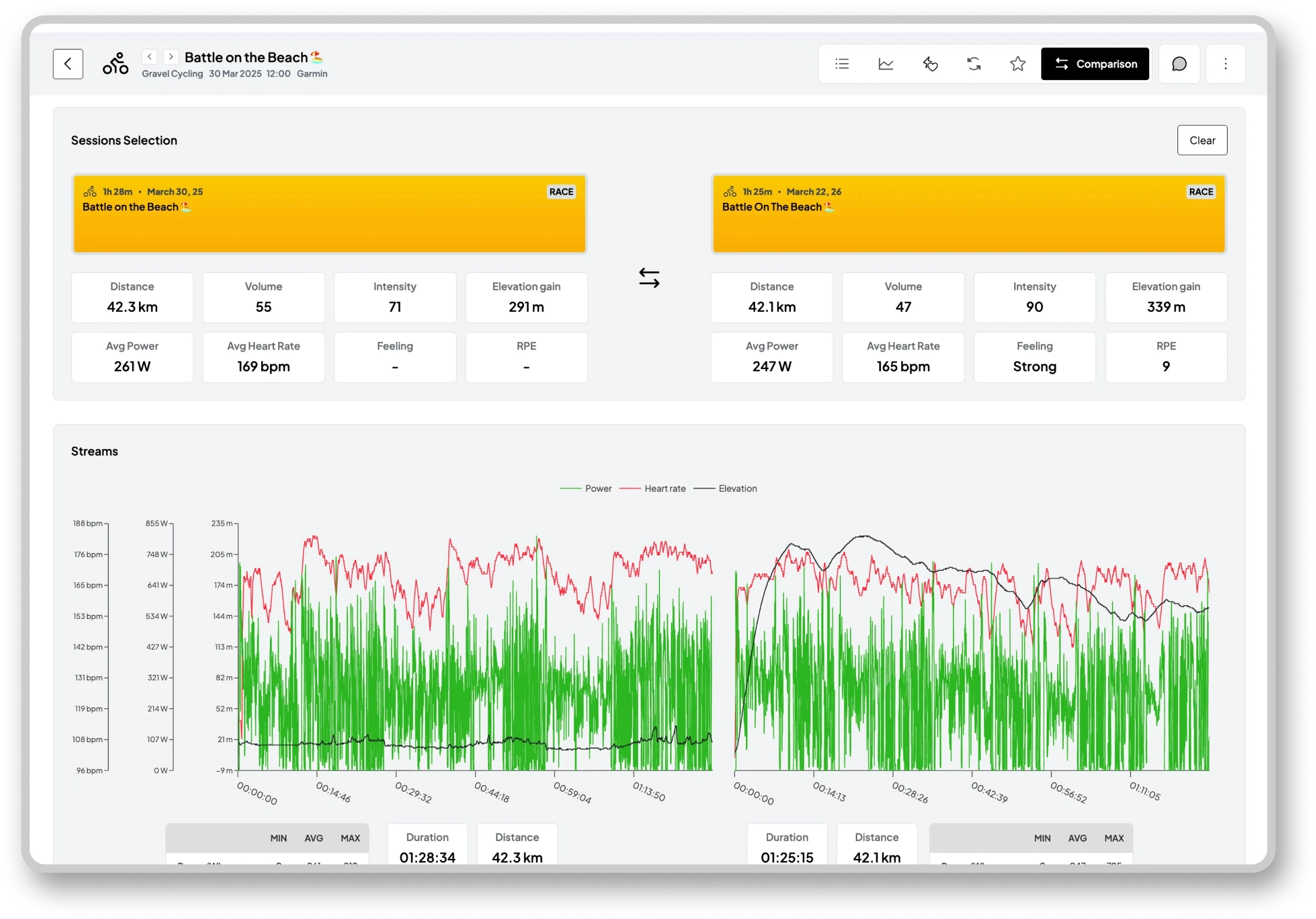
"I had an athlete do a race last Saturday that she also competed in the year prior. Using the compare ride feature, I was able to show her precisely that she got 8% better over 1', 16% over 20', on the same course. It becomes a number."
The last line is the one that matters. Improvement stops being a feeling. It becomes a number, attached to a course she remembers, against a version of herself she knows.
Moment Two. The Sprint That Looked Wrong.
Another athlete, the same week. She finished a race disappointed by a sprint effort that felt off. The peak number, in isolation, looked weak.
Peak power, on its own, tells you what someone produced. It does not tell you what it cost to produce it. A 1,000 watt sprint after 50 kilojoules per kilogram of accumulated work is not the same physiological event as the same sprint after 5 kJ/kg. One is fresh. The other is everything the rider had left.
Vekta's Durability view plots peak power against accumulated fatigue. The sprint Nick's athlete was disappointed by, plotted against the work she had already done in the race, was not a bad sprint at all. It was near a personal best for that level of fatigue. The number was honest. The disappointment was not.
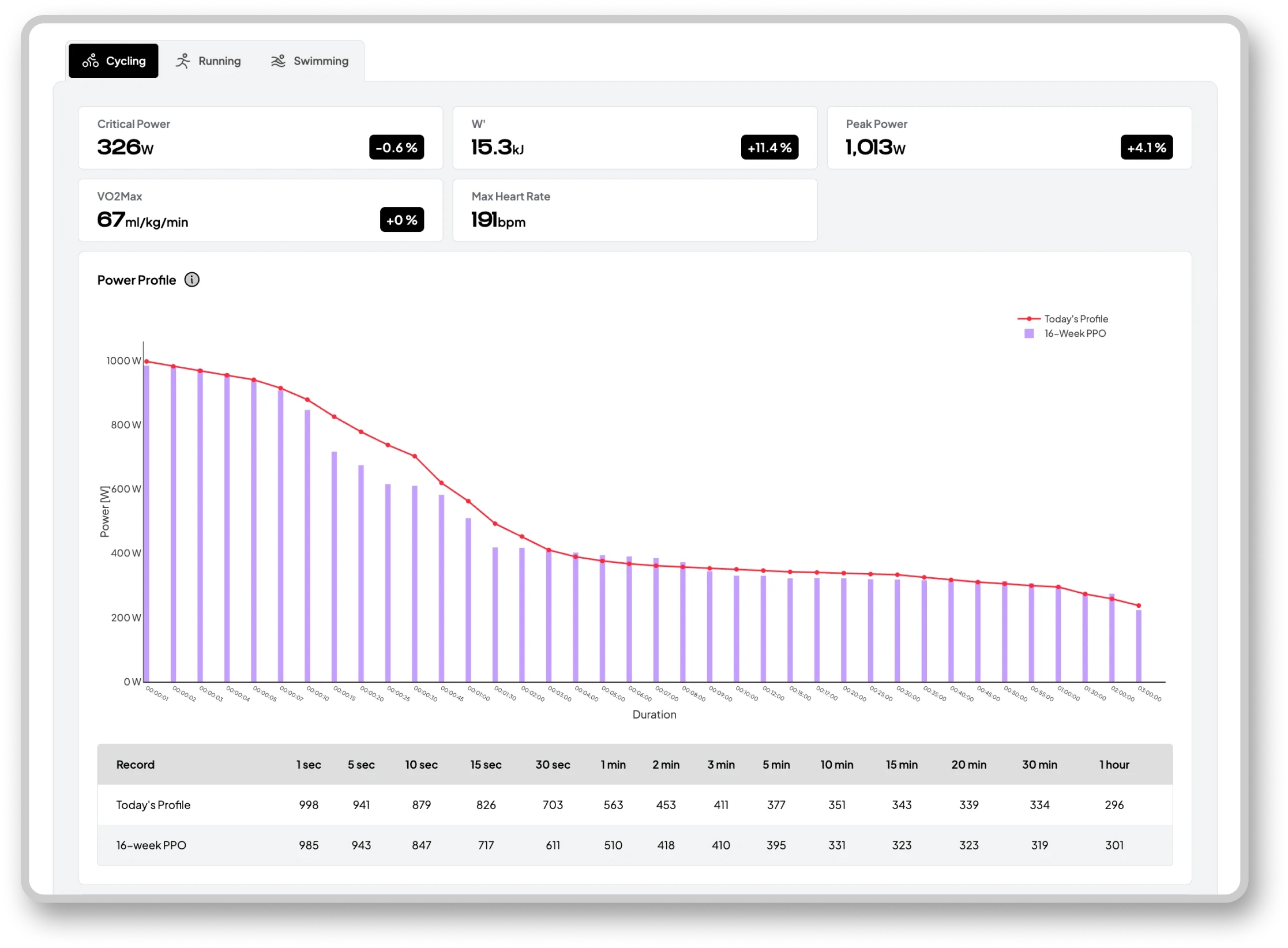
"I had an athlete disappointed after a bad sprint effort, but using the durability feature I was able to help her see that this bad sprint, when put into context of the race that happened beforehand, was actually near personal best."
A number in isolation can mislead an athlete about their own race. A number in context can give it back to them.
Moment Three. The Effort That Updated Itself.
A different rider, a hard fifteen-minute effort the day before. Not a planned test. Just a strong piece of riding within a normal session.
On platforms built around FTP, an effort like that prompts a coach decision. Was it a test? Do we update the number? If we do, by how much, and what zones follow? The math is extrapolation, and extrapolation is a guess. The athlete ends up training to a number that everyone, including the coach, knows is approximate.
In Vekta, the same effort behaves differently. Critical Power detected the new performance. CP updated immediately. Training zones recalibrated against the new ceiling. No retest scheduled, no week of recovery sacrificed, no extrapolated FTP adjustment.
"I had another rider do an amazing 15' effort yesterday and his CP got updated right away with his new zone recommendations. He told me he has more confidence that the CP number he sees is the right number."
That last sentence is the one to sit with. Athlete confidence in the number they train against is not a feature on a roadmap. It is the foundation of every workout that follows. Critical Power earns the confidence because it is observed, not estimated.
One Underlying Shift.
Three moments, one direction of travel. Coaches stop describing progress. They show it. Athletes stop hearing about improvement. They see it.
The conversation between them changes. So does the work.
Nick has also been clear with us that Vekta's Workout Builder has been night and day for his weekly preparation. Time returned, every week, across a roster. That is the wider context. The three moments above are what the conversation looks like once the rest of the week clears.
Nick Kleban, ChPC, coaches road, criterium, and gravel cyclists through Toguri Training.
Start your free 14-day trial or Book a Demo
Three Moments. One Coach. Nick Kleban on Coaching with Vekta.
A working week in a cycling coach's practice is built out of small judgements. A file lands on a Monday morning. An athlete asks a question on a Tuesday call. A power number on a Saturday race report either makes sense or it does not. None of these are headline events. They are the substance of the work.
Nick Kleban coaches out of Quebec. McGill Physiology graduate, former UCI Continental rider, Chartered Professional Coach. His practice, run through Toguri Training, blends structured endurance work with cycling-specific strength and sports nutrition. Three weeks ago, he and his athletes moved their analysis onto Vekta.
What follows are three moments from his recent coaching week. He wrote them up for us himself. The thread running through all three is the one Nick named in his own opening line. The conversation between coach and athlete has become clearer. Less about FTP as a single guess at fitness. More about the power curve, Critical Power, and W' as a shared language.
Moment One. The Race She Did Last Year.
A rider on Nick's roster lined up for a race last Saturday. She had done the same race the year before. Same course, twelve months of training in between.
In another tool, the question "did I get faster" gets answered by feel, or by digging through old files, or by trusting that the FTP number has moved. None of those are satisfying. None of them tell the athlete what changed and where.
Vekta's Workout Comparison lined the two efforts up side by side. Same course, same metrics, same intervals of time. The answer arrived in seconds. Eight percent better over one minute. Sixteen percent better over twenty minutes. The same shape of effort, ridden harder across the durations that mattered.
"I had an athlete do a race last Saturday that she also competed in the year prior. Using the compare ride feature, I was able to show her precisely that she got 8% better over 1', 16% over 20', on the same course. It becomes a number."
The last line is the one that matters. Improvement stops being a feeling. It becomes a number, attached to a course she remembers, against a version of herself she knows.
Moment Two. The Sprint That Looked Wrong.
Another athlete, the same week. She finished a race disappointed by a sprint effort that felt off. The peak number, in isolation, looked weak.
Peak power, on its own, tells you what someone produced. It does not tell you what it cost to produce it. A 1,000 watt sprint after 50 kilojoules per kilogram of accumulated work is not the same physiological event as the same sprint after 5 kJ/kg. One is fresh. The other is everything the rider had left.
Vekta's Durability view plots peak power against accumulated fatigue. The sprint Nick's athlete was disappointed by, plotted against the work she had already done in the race, was not a bad sprint at all. It was near a personal best for that level of fatigue. The number was honest. The disappointment was not.
"I had an athlete disappointed after a bad sprint effort, but using the durability feature I was able to help her see that this bad sprint, when put into context of the race that happened beforehand, was actually near personal best."
A number in isolation can mislead an athlete about their own race. A number in context can give it back to them.
Moment Three. The Effort That Updated Itself.
A different rider, a hard fifteen-minute effort the day before. Not a planned test. Just a strong piece of riding within a normal session.
On platforms built around FTP, an effort like that prompts a coach decision. Was it a test? Do we update the number? If we do, by how much, and what zones follow? The math is extrapolation, and extrapolation is a guess. The athlete ends up training to a number that everyone, including the coach, knows is approximate.
In Vekta, the same effort behaves differently. Critical Power detected the new performance. CP updated immediately. Training zones recalibrated against the new ceiling. No retest scheduled, no week of recovery sacrificed, no extrapolated FTP adjustment.
"I had another rider do an amazing 15' effort yesterday and his CP got updated right away with his new zone recommendations. He told me he has more confidence that the CP number he sees is the right number."
That last sentence is the one to sit with. Athlete confidence in the number they train against is not a feature on a roadmap. It is the foundation of every workout that follows. Critical Power earns the confidence because it is observed, not estimated.
One Underlying Shift.
Three moments, one direction of travel. Coaches stop describing progress. They show it. Athletes stop hearing about improvement. They see it.
The conversation between them changes. So does the work.
Nick has also been clear with us that Vekta's Workout Builder has been night and day for his weekly preparation. Time returned, every week, across a roster. That is the wider context. The three moments above are what the conversation looks like once the rest of the week clears.
Nick Kleban, ChPC, coaches road, criterium, and gravel cyclists through Toguri Training.
Start your free 14-day trial or Book a Demo

Try Vekta free
Put the theory to work
Vekta is where coaches and athletes plan the work, see the numbers, and track what actually changes.
Try Vekta free
Put the theory to work
Vekta is where coaches and athletes plan the work, see the numbers, and track what actually changes.
Frequently asked questions
Frequently asked questions

Brand Director