Coach
Coach
Coach
10
10
10
min
min
min
John Cox
John Cox
Escaping Structure with John Cox
Escaping Structure with John Cox
There is a point in every athlete’s development where following the plan perfectly stops being the same thing as training well.
John Cox, founder of Contour Endurance writes from inside that moment. Drawing on years of coaching experience, he examines the relationship between structure, perception, and performance, and how advances in analysis have quietly removed old barriers between discipline and freedom.
Escaping Structure
There's a counterintuitive principle in skills coaching: sometimes you have to teach someone the "right" way to do something before you can teach them to break the rule, or how not to rely on it.
Take braking, for example. When working with newer riders (or those that haven’t engaged in intentional practice), I start with clear, deliberate instruction: front brake for power, rear brake for control, apply them smoothly and progressively. Defined braking zones. We drill this through different challenges until it becomes second nature.
But once that foundation is solid, the real progression begins, teaching them to feel when to favour one over the other, when to brake harder, and most importantly, how to use this skill less to go faster. The structure gives them the language and baseline. Breaking free from it takes them to the next level.
The same dynamic exists in our endurance training.

Why Structured Training Matters
Structured workouts are fundamental to progress. They provide clear targets, repeatable benchmarks, and a framework for strategically building fitness. For athletes new to training with power or heart rate, structured intervals teach what different efforts actually feel like. Zone 2 isn't just a number; it's a sensation you learn to recognise. Your Critical Power isn’t a theoretical number; it's a turning point you learn to recognise, one you can use. A threshold interval isn't just hard; it's a specific kind of hard.
This is where consistency and commitment take root. Structure removes guesswork. It turns abstract goals into concrete actions that lead to progress.
But structure is a tool, not the destination.
The Cost of Attachment
When structure becomes too rigid, it starts to work against us.
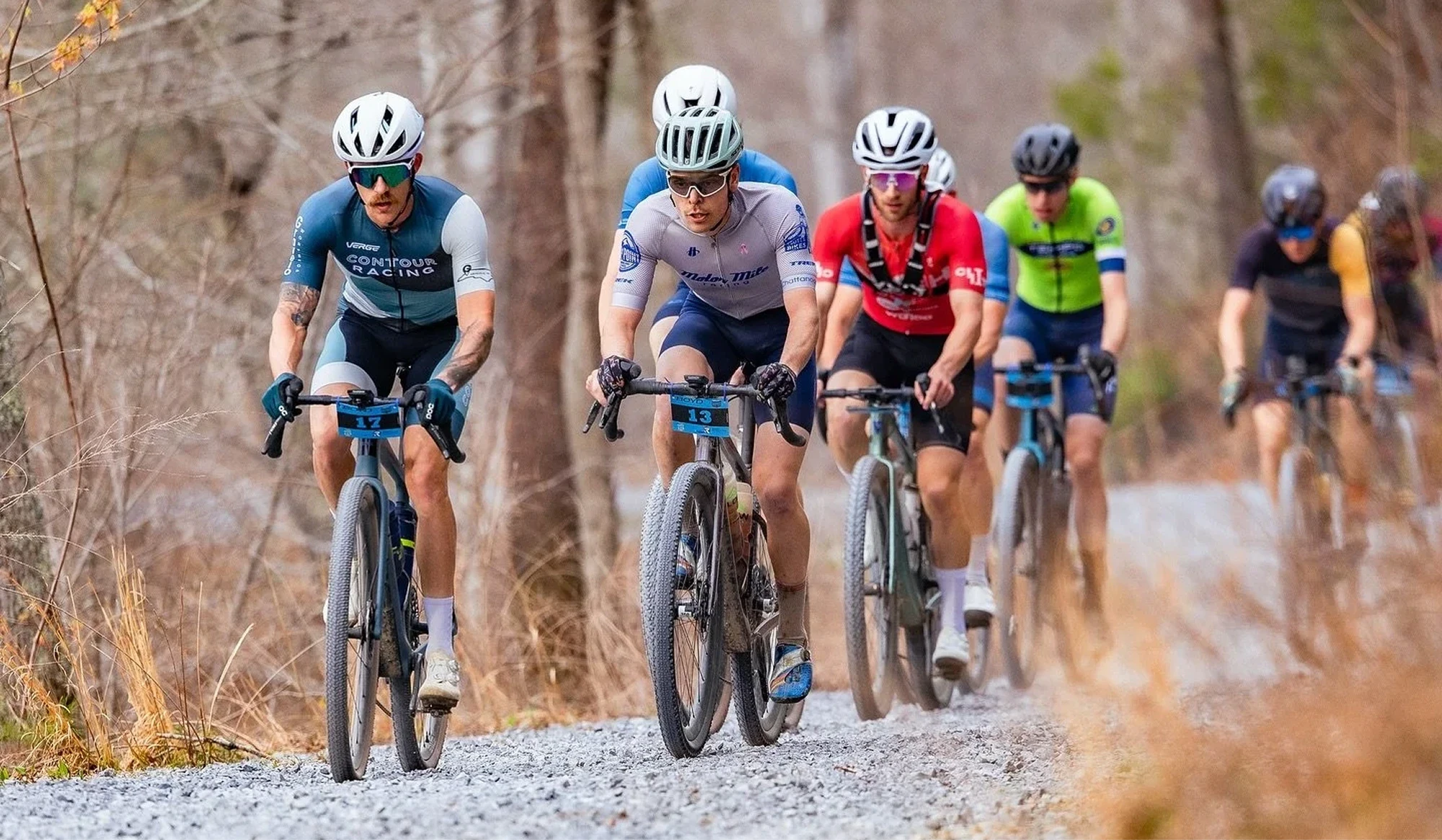
I've seen athletes become anxious when a workout doesn't go exactly as written, obsessing over a few missed watts, stopping intervals that were "off," or feeling like a ride without prescribed targets was wasted time, or god forbid it didn’t record at all.
The training plan, meant to create clarity, becomes a source of stress.
There's also a quieter cost: the erosion of rate of perceived exertion (RPE). Athletes can become so reliant on their head unit that they lose the ability to accurately sense their own effort. They stop asking, "How does this feel?" and only ask, "What do the numbers say?" That disconnection doesn't just limit race-day decision-making, it removes the most impactful feedback loop we have. We lose the introspection that helps us not only grow as athletes, but as whole people.
And then there's the feeling of being hemmed in. Training becomes a narrow set of prescribed actions, and anything outside that structure feels like a deviation rather than an opportunity. Athletes can become so locked into hitting the numbers that they miss what their body is actually telling them. Maybe the prescribed interval calls for 250 watts, but today 230 feels like the right ceiling, and pushing beyond that crosses the line from productive to counterproductive. Or maybe you're being held back, and you feel genuinely strong, and there's more in the tank worth exploring. The structure, meant to guide, starts to override judgment. You end up riding to the file instead of riding the bike.
Balance requires knowing when to hold the structure and when to let it go. This is where a good coach is invaluable. We work to integrate a balanced approach that embraces curiosity and introspection, while staying on track.
The Old Barrier: Analysis Without Structure Was Arduous
For years, unstructured rides created a practical problem. Without predefined intervals, post-ride analysis meant manually scrubbing through power files, trying to identify meaningful efforts, and piecing together what actually happened. It was time-consuming for coaches and often led to incomplete insight.
This made unstructured training harder to justify from a “performance management” perspective. Even when we knew an athlete needed creative freedom or a mental reset, the downstream workload discouraged it.
That barrier no longer exists.
What Vekta Changes
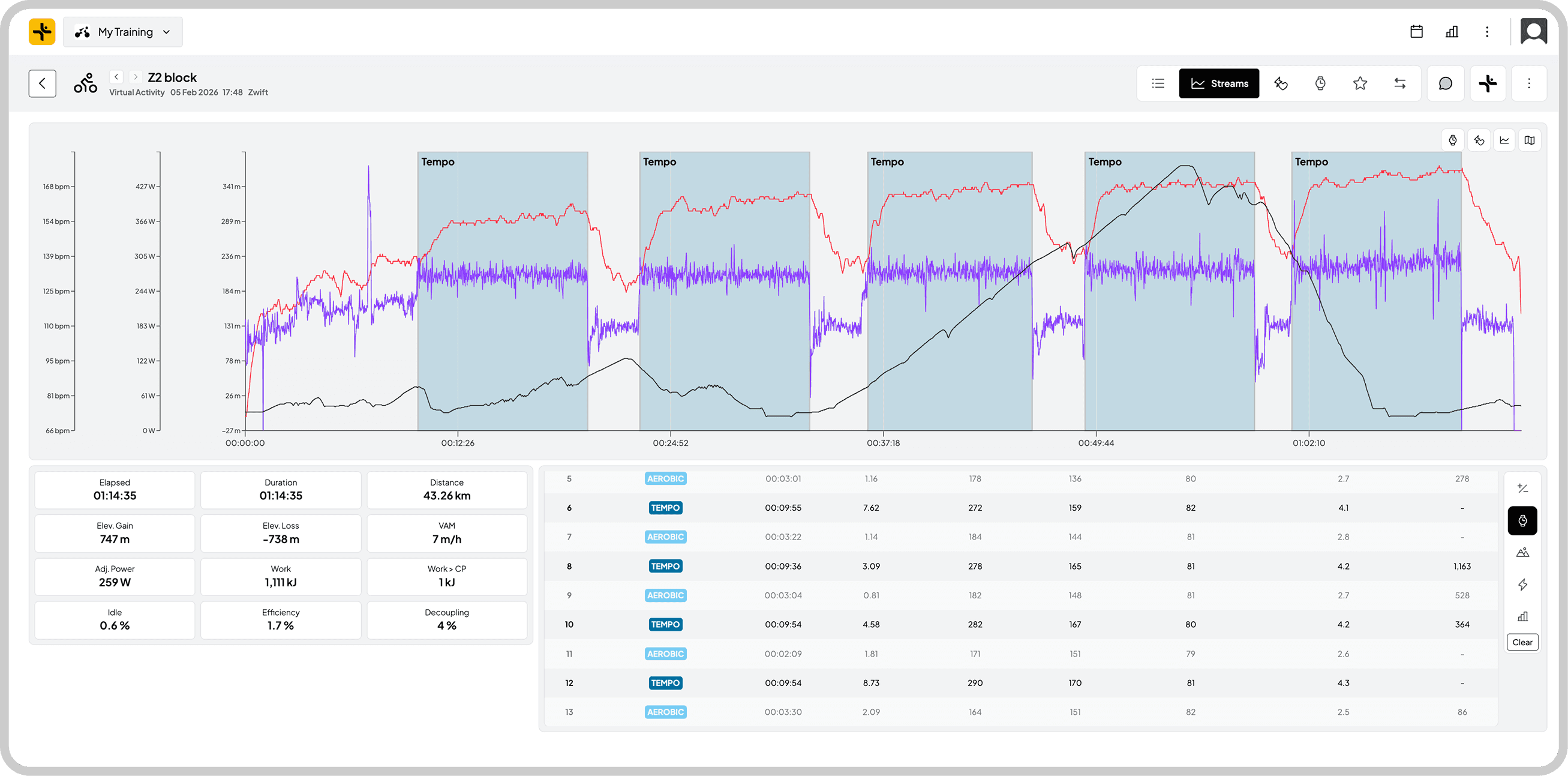
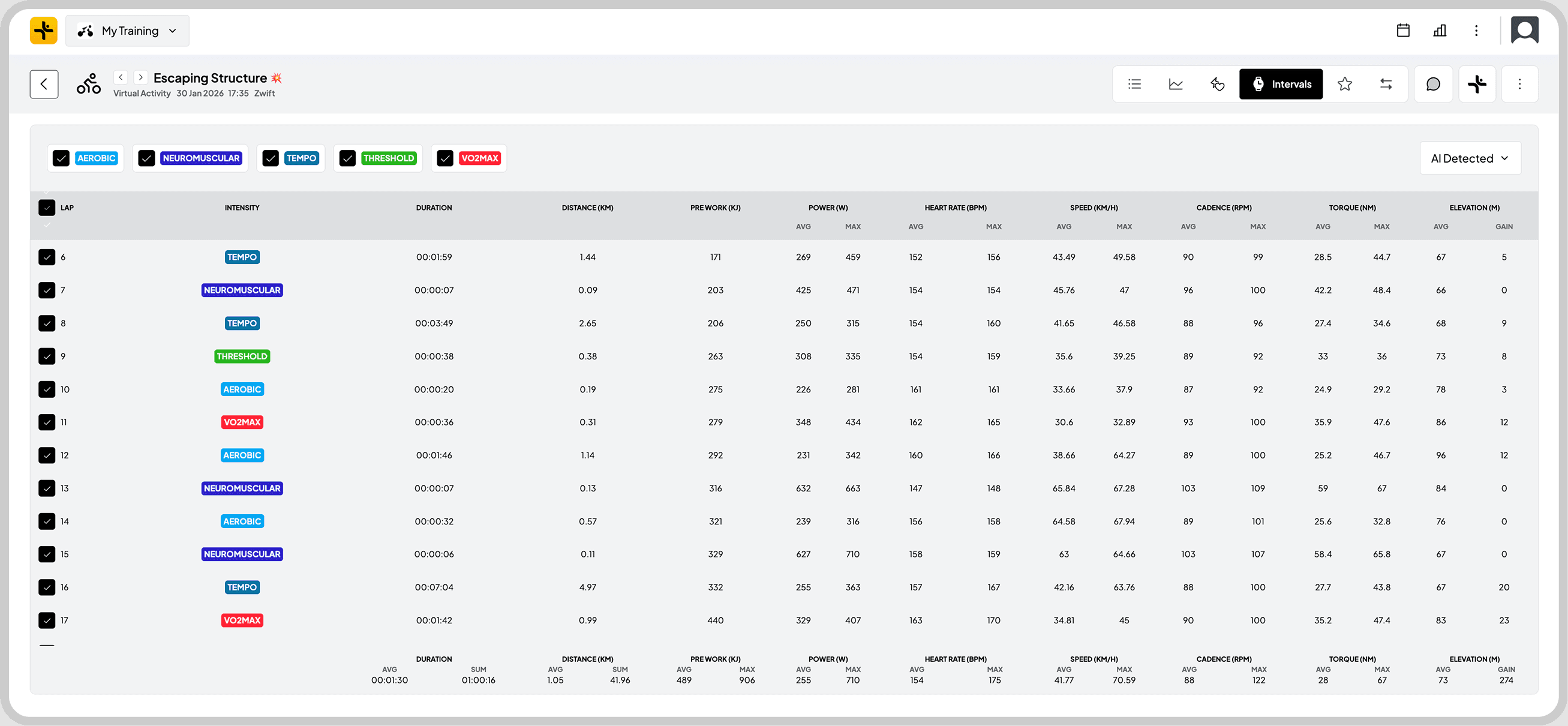
Vekta's Automatic Interval Detection tools identify and classify intervals automatically, whether they were planned or not. A spontaneous surge on a group ride, a spirited climb, a playful sprint; Vekta captures it, categorises it, and assigns training impact just as it would for a prescribed session. Vekta’s Automatic Interval Detection enables this approach by removing the need for manual session analysis.
This shifts the equation. Coaches can now encourage exploration without losing visibility. Athletes can ride intuitively and still get meaningful feedback on what they accomplished.
The result isn't chaos; it's measured freedom. You're still training with intention. You're still building toward goals. But you're no longer confined to a script.
And for many athletes, this brings something back that structured training can sometimes strip away: fun. The ability to respond to how the body feels, to chase an effort because the legs are there, to finish a ride and feel like you rode your bike, not just executed a file.
How to Use This
Structure remains the foundation (or should). These unstructured sessions don't replace your intervals, your long endurance rides, or your recovery/adaptation weeks; they enhance them.
The key is deploying them strategically within your broader plan. Consider weaving in unstructured sessions during:
Recovery or transition weeks: When intensity is lower, and the mental load of prescribed workouts might feel heavy.
Base phases: When aerobic development is the priority and rigid interval structure is less critical.
Between focused blocks: As a palate cleanser before ramping into the next training cycle.
Here are 5 examples of how I frame these sessions with my athletes:
Session Type | Session Name | Duration | How It’s Framed |
Accumulation Ride | Freestyle Tempo aka Motor Around | ~4h | No intervals today, let the structure go for a bit. Aim for 60–90 minutes of tempo riding total. This is the “I feel like I am going fast, but can do this for a long time” zone. Push a little on the climbs to keep it engaging, but the real goal is to enjoy the ride and give your head some space. |
Reactive Terrain Intervals | Terrain Threshold | 2–3h | Plan a route with a handful of climbs in the 8–30 min range (or sections that allow you to do some uninterrupted longer efforts) and look to feel out threshold. Look for that balance point of lactate we have been working on. Ideally, just have the map on your computer or put it in your pocket. Let's see how close you get. |
Group Ride | Efficiency & Tactics Practice | Variable | The goal today is to do as little power as possible, but be in the top 3 of every segment. We will compare this to the last couple of weeks. Take note of what you did differently. |
Simulation | Trail Intervals | ~2–3h | Warm Up 30 min with 1 min @ v02. Climb @ xco race pace directly into descent x 2 (no rest in between other than what the trail provides). Recover for 10–15 min. Repeat set of intervals. Cool down and have fun on the trails. |
Segments | VO₂ Max Smash | ~3.5h | Pick a route with some KOMs that take you 3–6 minutes. Go hard, but don't blow up early. Consistency across all of them is the goal. These should feel demanding. Breathing will be heavy, conversation impossible. If you're relieved when you crest the top, you're in the right place. Target 6 efforts total. They don't need to be evenly distributed, but roughly 2 each hour with plenty of recovery between. Let the terrain dictate the timing. No prescribed watts. No timer. Just you, the bike, and some well-earned suffering. |
These aren't "vibe rides" with no purpose. They're intentional training sessions with different constraints, ones that prioritise feel, spontaneity, and self-awareness while still contributing to your overall progression.

Key Takeaways
Structure teaches you the fundamentals. But, just like braking, sometimes you have to learn how to use it less to get faster. (and just like braking if you never use it, well, bad things..)
The goal is to build a training plan that uses both structure and flexibility; one where most of your work follows a clear, progressive framework, and select sessions create space to ride intuitively, recalibrate your RPE gauge, and stay mentally engaged.
Vekta's tools make this approach not only practical, but useful. You can train with structure when it serves you, explore when the moment calls for it, and still maintain clarity on what you've accomplished and where you're headed.
If you've been rigidly following every prescribed number, try building in occasional space to ride without a script. If you've been training entirely by feel, consider how deliberate structure might help you progress more efficiently.
The balance between the two is where long-term consistency and sustainable performance live. If you want a collaborative partner that can help you figure out how to integrate this into your training, please reach out to us.
Work with John
If you want to learn more about John’s coaching approach or explore working with him directly, visit Contour Endurance to see how he works with athletes to build structure, develop feel, and make better decisions in training and racing.
There is a point in every athlete’s development where following the plan perfectly stops being the same thing as training well.
John Cox, founder of Contour Endurance writes from inside that moment. Drawing on years of coaching experience, he examines the relationship between structure, perception, and performance, and how advances in analysis have quietly removed old barriers between discipline and freedom.
Escaping Structure
There's a counterintuitive principle in skills coaching: sometimes you have to teach someone the "right" way to do something before you can teach them to break the rule, or how not to rely on it.
Take braking, for example. When working with newer riders (or those that haven’t engaged in intentional practice), I start with clear, deliberate instruction: front brake for power, rear brake for control, apply them smoothly and progressively. Defined braking zones. We drill this through different challenges until it becomes second nature.
But once that foundation is solid, the real progression begins, teaching them to feel when to favour one over the other, when to brake harder, and most importantly, how to use this skill less to go faster. The structure gives them the language and baseline. Breaking free from it takes them to the next level.
The same dynamic exists in our endurance training.
Why Structured Training Matters
Structured workouts are fundamental to progress. They provide clear targets, repeatable benchmarks, and a framework for strategically building fitness. For athletes new to training with power or heart rate, structured intervals teach what different efforts actually feel like. Zone 2 isn't just a number; it's a sensation you learn to recognise. Your Critical Power isn’t a theoretical number; it's a turning point you learn to recognise, one you can use. A threshold interval isn't just hard; it's a specific kind of hard.
This is where consistency and commitment take root. Structure removes guesswork. It turns abstract goals into concrete actions that lead to progress.
But structure is a tool, not the destination.
The Cost of Attachment
When structure becomes too rigid, it starts to work against us.
I've seen athletes become anxious when a workout doesn't go exactly as written, obsessing over a few missed watts, stopping intervals that were "off," or feeling like a ride without prescribed targets was wasted time, or god forbid it didn’t record at all.
The training plan, meant to create clarity, becomes a source of stress.
There's also a quieter cost: the erosion of rate of perceived exertion (RPE). Athletes can become so reliant on their head unit that they lose the ability to accurately sense their own effort. They stop asking, "How does this feel?" and only ask, "What do the numbers say?" That disconnection doesn't just limit race-day decision-making, it removes the most impactful feedback loop we have. We lose the introspection that helps us not only grow as athletes, but as whole people.
And then there's the feeling of being hemmed in. Training becomes a narrow set of prescribed actions, and anything outside that structure feels like a deviation rather than an opportunity. Athletes can become so locked into hitting the numbers that they miss what their body is actually telling them. Maybe the prescribed interval calls for 250 watts, but today 230 feels like the right ceiling, and pushing beyond that crosses the line from productive to counterproductive. Or maybe you're being held back, and you feel genuinely strong, and there's more in the tank worth exploring. The structure, meant to guide, starts to override judgment. You end up riding to the file instead of riding the bike.
Balance requires knowing when to hold the structure and when to let it go. This is where a good coach is invaluable. We work to integrate a balanced approach that embraces curiosity and introspection, while staying on track.
The Old Barrier: Analysis Without Structure Was Arduous
For years, unstructured rides created a practical problem. Without predefined intervals, post-ride analysis meant manually scrubbing through power files, trying to identify meaningful efforts, and piecing together what actually happened. It was time-consuming for coaches and often led to incomplete insight.
This made unstructured training harder to justify from a “performance management” perspective. Even when we knew an athlete needed creative freedom or a mental reset, the downstream workload discouraged it.
That barrier no longer exists.
What Vekta Changes
Vekta's Automatic Interval Detection tools identify and classify intervals automatically, whether they were planned or not. A spontaneous surge on a group ride, a spirited climb, a playful sprint; Vekta captures it, categorises it, and assigns training impact just as it would for a prescribed session. Vekta’s Automatic Interval Detection enables this approach by removing the need for manual session analysis.
This shifts the equation. Coaches can now encourage exploration without losing visibility. Athletes can ride intuitively and still get meaningful feedback on what they accomplished.
The result isn't chaos; it's measured freedom. You're still training with intention. You're still building toward goals. But you're no longer confined to a script.
And for many athletes, this brings something back that structured training can sometimes strip away: fun. The ability to respond to how the body feels, to chase an effort because the legs are there, to finish a ride and feel like you rode your bike, not just executed a file.
How to Use This
Structure remains the foundation (or should). These unstructured sessions don't replace your intervals, your long endurance rides, or your recovery/adaptation weeks; they enhance them.
The key is deploying them strategically within your broader plan. Consider weaving in unstructured sessions during:
Recovery or transition weeks: When intensity is lower, and the mental load of prescribed workouts might feel heavy.
Base phases: When aerobic development is the priority and rigid interval structure is less critical.
Between focused blocks: As a palate cleanser before ramping into the next training cycle.
Here are 5 examples of how I frame these sessions with my athletes:
Session Type | Session Name | Duration | How It’s Framed |
Accumulation Ride | Freestyle Tempo aka Motor Around | ~4h | No intervals today, let the structure go for a bit. Aim for 60–90 minutes of tempo riding total. This is the “I feel like I am going fast, but can do this for a long time” zone. Push a little on the climbs to keep it engaging, but the real goal is to enjoy the ride and give your head some space. |
Reactive Terrain Intervals | Terrain Threshold | 2–3h | Plan a route with a handful of climbs in the 8–30 min range (or sections that allow you to do some uninterrupted longer efforts) and look to feel out threshold. Look for that balance point of lactate we have been working on. Ideally, just have the map on your computer or put it in your pocket. Let's see how close you get. |
Group Ride | Efficiency & Tactics Practice | Variable | The goal today is to do as little power as possible, but be in the top 3 of every segment. We will compare this to the last couple of weeks. Take note of what you did differently. |
Simulation | Trail Intervals | ~2–3h | Warm Up 30 min with 1 min @ v02. Climb @ xco race pace directly into descent x 2 (no rest in between other than what the trail provides). Recover for 10–15 min. Repeat set of intervals. Cool down and have fun on the trails. |
Segments | VO₂ Max Smash | ~3.5h | Pick a route with some KOMs that take you 3–6 minutes. Go hard, but don't blow up early. Consistency across all of them is the goal. These should feel demanding. Breathing will be heavy, conversation impossible. If you're relieved when you crest the top, you're in the right place. Target 6 efforts total. They don't need to be evenly distributed, but roughly 2 each hour with plenty of recovery between. Let the terrain dictate the timing. No prescribed watts. No timer. Just you, the bike, and some well-earned suffering. |
These aren't "vibe rides" with no purpose. They're intentional training sessions with different constraints, ones that prioritise feel, spontaneity, and self-awareness while still contributing to your overall progression.
Key Takeaways
Structure teaches you the fundamentals. But, just like braking, sometimes you have to learn how to use it less to get faster. (and just like braking if you never use it, well, bad things..)
The goal is to build a training plan that uses both structure and flexibility; one where most of your work follows a clear, progressive framework, and select sessions create space to ride intuitively, recalibrate your RPE gauge, and stay mentally engaged.
Vekta's tools make this approach not only practical, but useful. You can train with structure when it serves you, explore when the moment calls for it, and still maintain clarity on what you've accomplished and where you're headed.
If you've been rigidly following every prescribed number, try building in occasional space to ride without a script. If you've been training entirely by feel, consider how deliberate structure might help you progress more efficiently.
The balance between the two is where long-term consistency and sustainable performance live. If you want a collaborative partner that can help you figure out how to integrate this into your training, please reach out to us.
Work with John
If you want to learn more about John’s coaching approach or explore working with him directly, visit Contour Endurance to see how he works with athletes to build structure, develop feel, and make better decisions in training and racing.
Try Vekta free
Put the theory to work
Vekta is where coaches and athletes plan the work, see the numbers, and track what actually changes.
Try Vekta free
Put the theory to work
Vekta is where coaches and athletes plan the work, see the numbers, and track what actually changes.
Frequently asked questions
Frequently asked questions
Contour Endurance